


12 Aug ACP Sheets for Doors: Uses, Thickness and Limits
ACP sheets can be used as decorative faces or skins on suitable door assemblies, but they do not replace the engineered door core, frame, hinges, lock reinforcement, or required fire and security performance. A successful ACP-faced door combines the right panel finish with a stable substrate, compatible adhesive or mechanical details, protected edges, and hardware reinforcement designed for the complete door.
This distinction matters when buying. “ACP door” may describe a lightweight cabinet shutter, an interior swing door with ACP faces, a shopfront panel, or an exterior entrance assembly. These uses have different impact, moisture, wind, hardware, and code requirements.
Where ACP Fits in a Door Assembly
ACP is most often considered for the visible surface. The door beneath it may use a metal frame, timber-based core, honeycomb, mineral core, engineered board, or another construction selected by the door manufacturer. The face must remain adequately supported so normal opening, closing, impact, and temperature changes do not cause local buckling or bond failure.
| Application | ACP Can Contribute | What Must Be Designed Separately |
|---|---|---|
| Interior decorative door | Color, wood grain, smooth finish, cleanable face, and low added weight | Core stability, frame, hinges, lock reinforcement, edge sealing, and impact level |
| Cabinet shutter | Thin decorative surface and coordinated finish | Flatness, edge profile, hinge fixing, handle fixing, and repeated-cycle testing |
| Commercial service door | Replaceable decorative face or brand-color finish | High-traffic impact, trolley damage, kick plates, hardware, and maintenance access |
| Exterior entrance | Weather-resistant decorative surface when correctly specified | Water management, wind, thermal movement, corrosion, thresholds, security, and exterior-rated bonding |
| Fire-rated door | Only as a component expressly included in the tested or assessed door design | Complete certified door set, core, frame, seals, hardware, glazing, installation, and labeling |
Typical ACP-Faced Door Layer Concept
The diagram below is a purchasing and coordination concept, not a construction drawing. The responsible door designer must define the actual materials, bond line, core, frame, edges, and hardware.
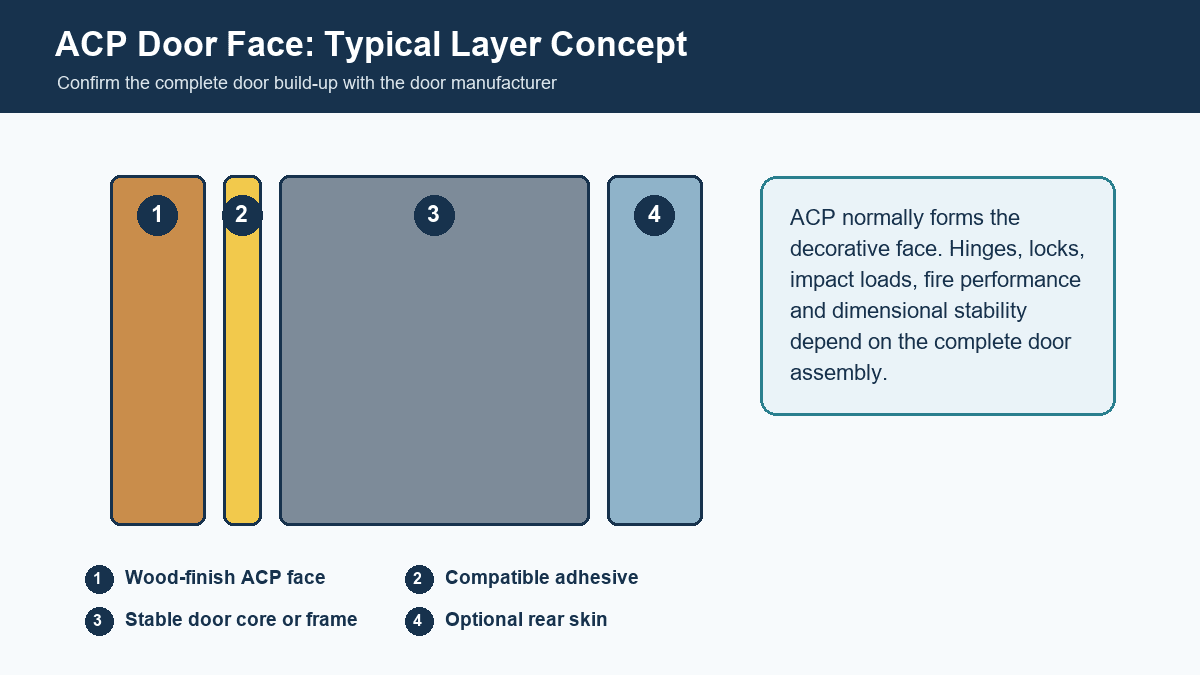
A bonded face must work with the substrate. Smooth ACP backs and some core materials may need preparation or a primer recommended by the adhesive supplier. The adhesive must tolerate service temperature, movement, moisture, and repeated door vibration. Uniform application and controlled pressure help avoid telegraphing, voids, or local distortion.
Balanced construction is also important. If one face has a different material, moisture response, or thermal behavior from the other, the door may bow. The door manufacturer should decide whether both sides require equivalent skins or another balancing layer.
How to Choose ACP Thickness for a Door
There is no universal ACP thickness for every door. A continuously bonded cabinet face, a large swing door, and an exterior entrance panel have different support and exposure. Total panel thickness is only one variable; aluminum skin thickness, panel dimensions, substrate flatness, edge restraint, and impact risk also affect the result.
Thinner decorative ACP may be considered when it is fully supported and the system has been validated. A thicker panel may provide more local rigidity, but it also changes weight, edge details, rebates, hardware clearance, and cost. A thick ACP face cannot compensate for a weak core or missing hinge reinforcement.
| Door Condition | Specification Priority | Questions to Resolve |
|---|---|---|
| Small cabinet or furniture shutter | Low weight, flatness, clean edges, suitable hinge fixing, and interior finish | Is the face continuously supported? How will edges and handles be fixed? |
| Standard interior swing door | Stable core, balanced faces, impact resistance, cleanability, and hardware reinforcement | What is the door size, traffic level, substrate, and bond system? |
| High-traffic commercial door | Impact protection, replaceability, kick-zone detailing, durable finish, and strong hardware zones | Will carts or equipment strike the face? Is a kick plate required? |
| Wet-area interior door | Sealed edges, moisture-stable core, compatible adhesive, and drainage/ventilation strategy | Can water enter cut edges or hardware penetrations? |
| Exterior entrance door | Exterior coating, thermal movement, weather seals, corrosion compatibility, wind, and security | Has the complete door been engineered and tested for outdoor service? |
Finish Options for ACP Door Faces
Solid colors create clean contemporary surfaces. Metallic and brushed finishes can coordinate with frames and hardware. Wood finishes provide a warmer appearance without using a solid timber face. Stone or other decorative effects may suit hospitality and retail interiors.
Choose gloss and texture with maintenance in mind. High-gloss dark finishes can show fingerprints and surface waviness. Very light colors may show dark marks in high-contact areas. Directional brushed or wood finishes must be installed consistently. Request a physical sample and review it vertically under the actual lighting.
The Alcadex wood ACP range provides design references for decorative applications, while the broader ACP product range shows additional finishes and customization options.
Edges, Hinges, Locks, and Handles
Door failures often start at details rather than the center of the face. Cut ACP edges should not be left where they can catch hands, absorb contamination, or receive repeated impact. Common concepts include folded returns, metal edge channels, framed edges, rebated profiles, and capped corners. The detail must allow for panel and substrate movement without creating a sharp edge.
Hinges, closers, pivots, locks, panic hardware, pulls, and handles should connect to reinforced parts of the door, not rely on a thin ACP skin for pull-out resistance. Cut-outs should have adequate clearance and edge support. Hardware screws must not crush the panel or create stress concentrations.
Dissimilar metals and cleaning chemicals can also create corrosion risks, especially at exterior or wet locations. Select compatible fasteners and isolate materials where necessary. Protect freshly cut areas from swarf, moisture traps, and aggressive sealants.
Fire, Smoke, Security, and Acoustic Limits
An ACP sheet does not give a door a fire rating. Fire performance belongs to a tested or assessed door set containing the leaf, core, faces, frame, seals, hardware, glazing, gaps, and installation method. The classification, test standard, field of application, and labeling requirements must match the building jurisdiction.
The same system principle applies to smoke leakage, forced-entry resistance, wind pressure, acoustic ratings, and thermal performance. A decorative face may influence weight or surface behavior, but it is not proof that the completed door meets a target. Obtain documentation from the responsible door-system supplier.
Choose a Stable Door Core and Substrate
The substrate must stay flat under the temperature and humidity range expected in service. Timber-based boards can move with moisture; metal frames can create local read-through; honeycomb and foam cores require compatible face bonding and edge closure. Existing doors may contain coatings, release agents, contamination, dents, or unknown materials that make over-cladding unreliable.
Before production, document substrate material, density or grade, thickness, surface finish, moisture condition, flatness tolerance, and any primer. Adhesive suppliers may require peel or shear tests on the actual materials. A bond that looks strong after one day may behave differently after heat, moisture, or repeated opening cycles, so project-appropriate conditioning and testing are valuable.
The core should also contain reinforcement where hardware loads enter the leaf. Concealed closers, pivots, large pulls, panic bars, electronic locks, door stops, and access-control devices may need different reinforcement zones. Coordinate these before laminating the ACP face; cutting later can expose unsupported cavities and damage the finish.
Prototype and Testing Plan
For a new door build-up, manufacture at least one representative prototype using production materials and processes. It should include the real leaf size, ACP finish and direction, edge detail, hardware cut-outs, adhesive, cure cycle, seals, and frame clearances. A small coupon can help screen an adhesive, but it cannot reveal full-door bow or hardware interaction.
Inspection may include overall dimensions, diagonal squareness, face flatness, edge safety, coating damage, bond coverage, opening force, latch alignment, hinge movement, closer operation, and repeated cycles. Exterior prototypes may also need water, thermal, wind, and corrosion evaluation. Rated or security doors require the formal testing and documentation specified by the responsible system provider and jurisdiction.
Keep the accepted prototype or signed sample as the production reference. Record any approved changes in drawings and bills of materials. Substituting the adhesive, core, ACP, hardware, or edge profile after approval can change behavior even when the visible color remains the same.
Cleaning, Repair, and Replacement
Door faces receive more touch and impact than many wall panels. Establish a cleaning method for fingerprints, oils, dust, and disinfectants. Use soft cloths and products compatible with the coating; test them on a spare sample. Abrasive pads can alter gloss, while strong solvents can affect coating, adhesive squeeze-out, sealants, or printed graphics.
Plan high-wear zones deliberately. Kick plates, push plates, edge guards, replaceable lower panels, or sacrificial trims can protect the decorative face. If a damaged ACP skin is intended to be replaceable, the attachment and edge system must allow removal without destroying the door core or adjacent finish.
Store a small quantity of labeled material from the approved batch for repairs where appearance continuity is critical. A later batch may differ slightly in color, gloss, or grain even when it uses the same product code. Replacement panels must also preserve the door’s documented fire, security, and other performance.
Fabrication and Bonding Workflow
- Confirm the door performance brief. Record location, size, opening direction, traffic, exposure, fire or security requirements, and hardware.
- Select the complete door construction. Define frame, core, reinforcement, ACP face, rear face, edges, seals, and compatible materials.
- Approve a full-size detail or prototype. Check flatness, color direction, bond quality, edges, clearances, hardware, and opening cycles.
- Control surface preparation. Follow the adhesive manufacturer’s instructions for cleaning, abrasion, primer, application rate, pressure, and cure time.
- Fabricate clean openings. Support cut-outs and remove swarf without scratching the coated surface.
- Inspect before installation. Check bow, dimensions, edge safety, finish, batch, hardware reinforcement, and protective film removal timing.
These steps describe quality control, not a universal installation method. The actual door-system manufacturer should issue job-specific drawings and procedures. For projects requiring routed, cut, or machined ACP parts, Alcadex can review drawings as part of its panel processing capability.
ACP Door Buying Checklist
| RFQ Item | Information to Provide | Reason |
|---|---|---|
| Door type and location | Interior, exterior, cabinet, entrance, service, or rated door | Defines exposure and responsible system requirements |
| Door dimensions and quantity | Leaf width, height, thickness, handing, and count | Affects face yield, weight, frame, and hardware |
| ACP specification | Size, total thickness, aluminum skins, core, coating, finish, gloss, and direction | Creates a comparable panel quotation |
| Door core and substrate | Material, density or grade, surface condition, and moisture behavior | Needed for flatness and bond-system selection |
| Performance | Fire, smoke, acoustic, security, impact, wind, moisture, and durability targets | Must be verified for the complete door set |
| Edges and hardware | Profiles, folds, locksets, hinges, closers, handles, kick plates, and reinforcement | Prevents unsupported fixing and unsafe cut edges |
| Processing and delivery | Drawings, tolerances, labels, packing, Incoterm, destination, and date | Controls manufacturing scope and landed cost |
Common Mistakes to Avoid
- Using an ACP sheet as if it were the structural door leaf.
- Attaching hinges or locks only to the decorative skin.
- Bonding one face without checking whether the door remains balanced and flat.
- Leaving cut edges or hardware openings unsupported and unprotected.
- Using an interior coating or adhesive on an exterior entrance.
- Assuming an ACP core classification automatically gives the door a fire rating.
- Approving color from a screen instead of a labeled physical sample.
- Starting production without a prototype for a new door build-up.
Frequently Asked Questions
Can ACP sheets be used to make doors?
They can be used as decorative faces in a properly designed door assembly. The core, frame, reinforcement, edges, adhesive, hardware, and required performance must be specified separately.
What ACP thickness is best for a door?
No single thickness fits every door. Select it from face support, door size, aluminum skins, impact level, weight, edge design, environment, and the tested or engineered assembly.
Can wood ACP be used on a door?
Yes, for suitable decorative applications. Confirm finish direction, interior or exterior coating, cleaning needs, edge details, bond compatibility, and complete door performance.
Is an ACP-faced door fire rated?
Only if the exact complete door set has valid test or assessment documentation for the required classification. The ACP sheet alone does not establish the rating.
Can screws be fixed directly into ACP?
Hardware carrying repeated or safety-critical loads should fix into designed reinforcement or the structural frame. Do not rely on a thin decorative skin alone.
Request ACP Samples for a Door Project
Send the door type, location, dimensions, substrate, finish, panel specification, quantity, processing drawings, performance targets, packing, and destination. Alcadex can review the ACP portion of the requirement; the responsible door-system provider must confirm the completed assembly.
Contact Alcadex to request ACP color samples and a specification-based quotation for your door project.