
15 Sep ACM Panels for Trailers: Weight, Finish and Fixing
ACM panels for trailers are lightweight aluminum composite sheets used as exterior skins, interior liners or non-structural infill within an engineered trailer body. A suitable panel cannot be selected from total thickness alone. Buyers must define the aluminum skins, core, surface finish, panel weight, joint layout, attachment method, supporting frame and service environment as one coordinated specification.
Alcadex product information identifies transportation and trailer cladding as applications for aluminum composite panels. The final configuration still depends on the trailer design, road vibration, moisture exposure, cleaning chemicals, expected impact, local transport rules and the body builder’s engineering. This guide explains how to prepare a comparable RFQ without treating the panel as a complete trailer wall system.
Where ACM panels fit in a trailer body
ACM can provide a smooth, corrosion-resistant-facing surface at relatively low panel weight. It is commonly evaluated for side skins, front or rear panels, interior lining, doors, partitions, equipment enclosures and display areas. The panel may be mechanically fastened, bonded, captured in profiles or installed through a combined method.
The important boundary is structural responsibility. Standard ACM should not automatically be treated as a primary load-bearing member. The trailer frame, rails, posts, cross-members, joint profiles and attachments carry and distribute loads according to the body design. Panel stiffness, local support and attachment behavior still matter, but they must be checked as part of that assembly.
| Trailer location | Main buyer concern | Specification focus | Do not assume |
|---|---|---|---|
| Exterior side skin | Appearance, weather exposure, vibration and joint movement | Finish, skin thickness, flatness, module size, frame spacing and attachment | That an architectural coating automatically suits every road environment |
| Front or lower zone | Water, debris and higher local impact risk | Protected edges, replaceable modules, backing and cleaning resistance | That the same thin panel used high on the wall suits the impact zone |
| Interior liner | Cleaning, abrasion and cargo contact | Surface durability, edge sealing, joint hygiene and substrate support | That an exterior finish is automatically the best interior finish |
| Door or access panel | Repeated movement, hardware loads and edge damage | Frame design, returns, inserts, hinges, latches and replaceability | That hardware can be fixed only through the composite sheet |
| Sign or branded area | Color, graphics and repair matching | Approved sample, gloss, batch control and graphic system | That a screen color is a production color standard |
Specify panel construction before comparing weight
A trailer buyer usually wants to reduce mass, but a quoted weight is meaningful only when construction is complete. Total thickness, front and rear aluminum skin thickness, core type and density, coating layers, protective film and any attached backing all contribute to the delivered panel. Two sheets with the same nominal thickness can have different skin gauges and different area weights.
Ask each supplier to state panel mass in one consistent unit, such as kilograms per square meter, and identify whether the value is nominal, calculated or measured. Then compare the value with the actual module area, cut-outs, joint profiles, adhesives, fasteners and support members. A lighter sheet can require closer support or additional attachments, eliminating part of the expected saving.
The weight decision also affects handling. Large, thin modules can be light enough for manual movement but remain vulnerable to bending, edge impact and surface marking. Define lifting, storage and protective-film requirements before production, particularly when the panels will be shipped to a separate body-building plant.
Match skin and core choices to the service zone
The aluminum skins provide the visible surface and contribute to local dent resistance, screw-bearing behavior and fabrication quality. Increasing the skin thickness can improve resistance to local handling damage when other variables remain comparable, but it also increases mass and cost. Final selection should reflect support spacing, panel dimensions, impact exposure and attachment design.
The core keeps the skins separated and contributes to composite action. Core descriptions such as polyethylene or mineral-filled do not establish complete wall performance. A core selected for one building application should not be transferred to a trailer without reviewing vibration, temperature cycling, moisture, bonding and any applicable fire or transport requirements.
Write both skin thicknesses separately in the RFQ. Do not accept a quotation that states only “3 mm ACM” or “4 mm ACM.” Also identify alloy or material requirements only when the trailer engineer has defined them. Alcadex configurations vary by product and order specification, so the quotation and approved sample must control the final construction.
Choose a finish for exposure and maintenance
Finish selection begins with where the trailer operates and how it is maintained. Outdoor road service exposes surfaces to sunlight, water, airborne dirt, temperature changes and repeated washing. Interior liners may face cleaners, abrasion, cargo contact or food-service hygiene procedures. A finish suitable for a building facade is not automatically validated for those conditions.
Define color, gloss, coating system, nominal dry-film thickness when relevant, and the approved visual standard. Metallic finishes require special attention to orientation because panels installed in different directions can reflect light differently. Dark colors can make surface waviness and temperature effects more visible. A physical sample from the intended production route is more reliable than a digital color reference.
For repeat fleets, record the approved color code, physical master, gloss range and batch identification. The Alcadex guide to ACP color variation and batch approval explains why replacement panels should be controlled against the original approval rather than a color name alone. When coating thickness is a contractual requirement, define the measurement basis described in the ACP dry-film thickness guide.
Coordinate joints, frame movement and water paths
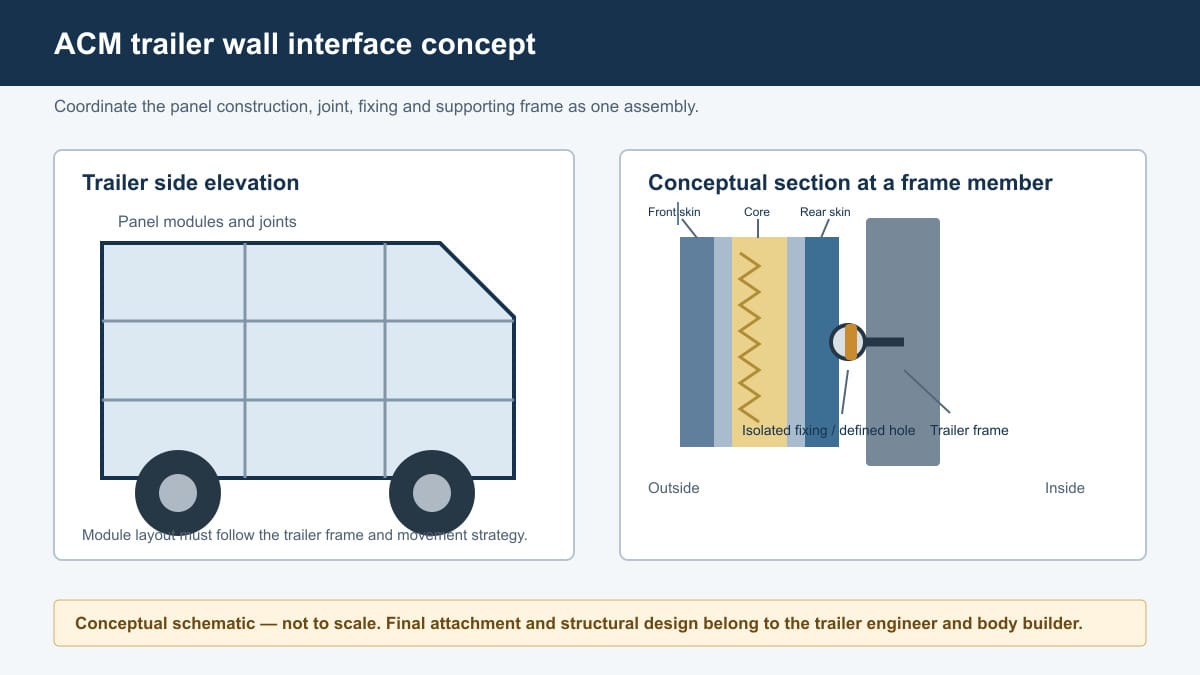
Trailer walls move. The metal frame changes dimension with temperature, the body twists during service, and joints experience vibration. Panel modules, hole geometry, sealants, tapes and profiles must accommodate the movements expected by the body designer. Locking every edge rigidly can transfer stress into the skins, fasteners or bond line.
Joint design must also manage water. Horizontal laps, open edges and exposed core should not collect moisture. Define drainage paths, sealant compatibility, end closures and repair access. If a sealant or adhesive touches the panel coating, confirm compatibility with the actual finish and surface preparation.
Do not rely on a drawing that shows only panel outlines. It should identify frame members, joint widths, fixed and movement points, fastener locations, hole sizes, edge distances, sealant or tape zones, corner treatments and penetrations. This information lets the panel supplier and fabricator review whether the proposed module can be made, packed and installed consistently.
Compare mechanical fixing, bonding and captured edges
| Attachment approach | Useful characteristics | Main controls | Typical risk if poorly coordinated |
|---|---|---|---|
| Mechanical fasteners | Visible, inspectable and replaceable connections | Fastener material, head or washer, hole size, edge distance, torque and frame thickness | Local crushing, pull-through, loose joints, restricted movement or corrosion |
| Structural adhesive or tape | Continuous load distribution and a clean exterior face | Approved product, substrate preparation, bond width, thickness, cure and environmental limits | Loss of adhesion, trapped moisture or unverified bond durability |
| Captured profile | Protected edges and modular assembly | Engagement depth, isolators, drainage, tolerances and profile attachment | Rattle, edge wear, water retention or panel disengagement |
| Hybrid attachment | Can combine positioning, bonding and mechanical restraint | Clear load-sharing intent and compatible materials | One component prevents the movement intended by another |
Mechanical fixings need a load path into the supporting frame. The panel skin and core alone may not be suitable for concentrated hinge, latch, tie-down or equipment loads. Use local reinforcement, inserts or framed openings where the engineer requires them. For ordinary rivets and screws, the ACP fastener comparison and the guide to drilling, edge distance and hole design provide useful coordination questions.
Dissimilar metals and wet road environments can create corrosion risks. Confirm fastener, frame and panel compatibility, and specify isolating washers, coatings or separators where required by the body design. The supplier should not substitute fastener material or surface treatment without written approval.
Control fabrication without weakening the panel
Trailer modules often include windows, lights, vents, handles and access doors. Each opening changes the stress path and creates edges that can be damaged or exposed. The fabrication drawing should show minimum remaining material, corner radii, reinforcement, edge closures and the relationship between openings and frame members.
Routing and folding must leave a controlled remaining skin where a cassette or return is formed. Excessive routing depth can cut or score the outer skin; insufficient depth can produce a poor fold or surface distortion. Use a first-off sample before repeating a large batch. The Alcadex V-grooving inspection guide explains the variables that should be recorded.
Keep the protective film in place through appropriate fabrication and handling, but do not leave it on beyond the supplier’s stated exposure limits. Identify the finish direction and panel code on the rear surface. That makes it easier to install metallic or directional finishes consistently and replace a damaged module later.
Plan handling, packaging and replacement
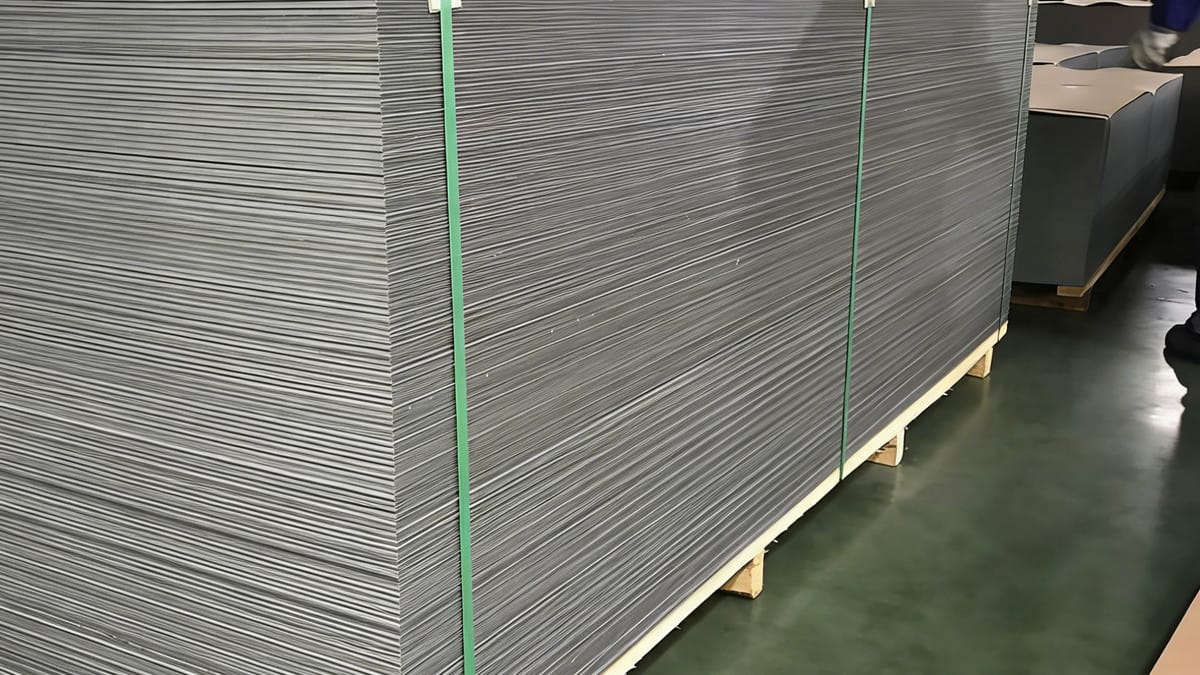
Finished trailer panels may travel through several facilities before installation. Flat support, clean separators, protected corners and a stable package reduce scratches, edge dents and panel bow. If components are delivered in installation sequence, mark each piece and package so workers do not need to drag finished panels across one another.
Agree on the inspection point where responsibility transfers. The supplier can record dimensions, finish, quantity and visible condition before packing. The receiver should inspect external package damage, labels and representative panels promptly. The ACP packaging guide provides a practical framework for pallets, cases and surface protection.
Fleet operators should also plan replacement. Retain the color approval, panel construction, production batch, drawing revision and hole pattern. A replacement sheet with the same color name may differ in gloss or visible shade, and a nominally similar panel may not match the original skin or core construction.
Build a comparable trailer-panel RFQ
| RFQ field | Information to provide or request | Why it matters |
|---|---|---|
| Trailer use | Exterior skin, interior liner, door, partition or branded panel; operating environment and cleaning method | Sets the exposure and damage assumptions |
| Panel construction | Total thickness, front and rear skin thickness, core type, finish and rear-surface treatment | Makes weight and performance comparisons meaningful |
| Dimensions | Finished module size, raw-sheet size, tolerances, squareness, cut-outs and direction marks | Controls fit, yield and replacement compatibility |
| Weight | Nominal area weight, calculation basis and tolerance | Supports trailer mass planning without comparing unlike panels |
| Finish approval | Color code, physical sample, gloss, coating system and batch-control method | Reduces visible mismatch across a fleet |
| Attachment interface | Frame material, support spacing, fixing or bonding method, holes, edge distance and isolators | Connects the panel to the engineered body system |
| Fabrication | Cutting, routing, folding, drilling, edge closure, coding and first-off approval | Prevents process assumptions from changing the design |
| Packaging | Protection film, separators, corner protection, pallet or case, labels and unloading method | Controls damage before installation |
| Evidence | Product data, approved sample, dimension report, finish records and any project-required test documents | Provides an auditable basis for release |
Send the same RFQ and drawing revision to every supplier. When quotations differ, compare each field instead of comparing only price per sheet. The ACP technical submittal guide can help organize product data, samples and revisions before production release.
Common specification mistakes
- Quoting only total thickness: this hides skin and core differences that affect mass, fabrication and local damage resistance.
- Using an architectural finish name as full approval: the actual color, gloss, coating build and cleaning exposure still need definition.
- Leaving fixings to the installer: holes, edge distance, frame thickness, movement and corrosion isolation must be coordinated before production.
- Loading hardware through the sheet alone: hinges, latches and equipment may require framed openings or local reinforcement.
- Ignoring replacement records: missing batch, drawing and finish data makes fleet repairs slower and less consistent.
- Treating a panel certificate as system approval: the complete trailer body remains subject to engineering and applicable rules.
FAQ
Are ACM panels structural in a trailer wall?
Do not assume they are primary structural members. The trailer engineer must define how the frame, skins, core, joints and attachments share loads. Standard product data alone does not establish complete wall capacity.
What thickness is best for a trailer?
There is no universal best thickness. Module size, skin gauges, core, support spacing, impact zone, fixing method and weight target all matter. Ask suppliers to quote the same complete construction and let the body design control the selection.
Should trailer panels use PVDF coating?
PVDF may be considered for outdoor exposure, but the coating system must be reviewed against the actual road environment, cleaning process, forming method and appearance requirement. Do not select it from the resin name alone.
Can ACM be bonded directly to a steel frame?
Only when the specified adhesive or tape, surface preparation, bond geometry, cure conditions, movement and corrosion isolation have been validated for the assembly. Follow the trailer designer’s approved attachment system.
How should buyers compare panel weight?
Use the same unit and the same declared construction. Request area weight and its basis, then include profiles, adhesives, fasteners and any added support when estimating the installed body mass.
Request a project-specific Alcadex quotation
If you are sourcing ACM panels for a trailer or vehicle-body program, send Alcadex the intended panel location, dimensions, skin and core requirements, finish, attachment concept, quantity, packaging method and destination. Request product samples, technical data and a quotation based on the same written specification. Contact Alcadex to review available configurations for your project.