

08 Sep Aluminum Honeycomb Core: Cell Size and Foil Gauge
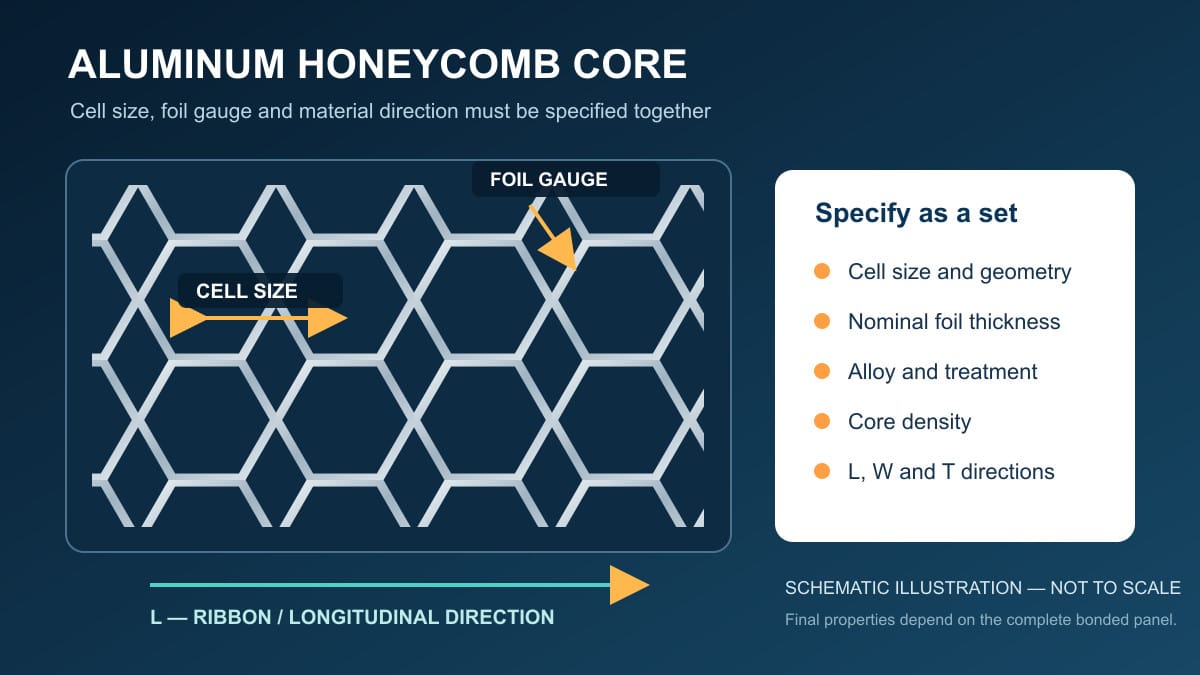
Aluminum honeycomb core is an expanded network of thin aluminum foil formed into repeated cells and used between face sheets in lightweight sandwich panels. Cell size describes the width of the cell opening, while foil gauge describes the nominal thickness of the aluminum foil that forms the cell walls. Neither value should be selected alone: alloy, core density, core thickness, ribbon direction, corrosion treatment, face sheets, adhesive and panel geometry all affect the finished panel.
For buyers, the practical objective is not to request “small cells” or “heavy foil” in isolation. It is to define a repeatable core configuration, connect it to the required panel performance and make every supplier quote the same construction. This guide explains the vocabulary, the main design tendencies and the records needed for a comparable quotation.
Key aluminum honeycomb core terms
| Specification term | What it describes | Why it matters | Buyer check |
|---|---|---|---|
| Cell size | Nominal dimension of the repeated cell opening under the supplier’s stated convention | Influences density, local support beneath the face sheet, handling and available product range | Record the value, unit and measurement convention |
| Foil gauge | Nominal thickness of the aluminum foil forming the cell walls | Contributes to core density and mechanical properties | State whether the value is nominal and how it is verified |
| Core density | Mass per unit volume of the expanded core | Provides a more complete indicator than cell size or foil gauge alone | Request the nominal density and permitted tolerance |
| Core thickness (T) | Depth of the honeycomb between the bonded face sheets | Strongly influences sandwich-panel geometry and overall depth | Do not confuse it with total finished-panel thickness |
| L and W directions | Ribbon or longitudinal direction and the transverse direction | Honeycomb properties can differ by direction | Show orientation on drawings and test reports |
| Alloy and treatment | Foil material and any specified corrosion-resistant treatment | Affects material properties and suitability for the intended environment | Identify the actual grade and treatment in the submittal |
A compact core designation may combine several of these fields. The official Hexcel honeycomb attributes guide, for example, explains a naming sequence that includes material type, cell size, alloy, foil thickness and density. The exact code is supplier-specific, so a buyer should translate it into plain-language values rather than compare product codes by appearance.
How cell size and foil gauge work together
Cell size and foil gauge are geometric inputs, not complete performance grades. If alloy, cell geometry and other variables remain comparable, reducing cell size generally increases the amount of cell wall material within a given volume. Increasing foil thickness also adds material. Either change can raise core density, but real catalog combinations are discrete and the relationship is not captured safely by a simple universal formula.
The bonded sandwich panel adds another layer of behavior. A smaller cell can provide more frequent support beneath a thin face sheet, which may help reduce local dimpling or print-through under some fabrication and loading conditions. A thicker foil can change core strength and handling resistance. However, the outcome still depends on face-sheet thickness, adhesive coverage, cure, core depth, panel span, support conditions and loading direction.
| Change, with other variables comparable | Typical directional effect | Possible trade-off | What must still be verified |
|---|---|---|---|
| Smaller cell size | More cells and cell walls across a given panel area; more frequent support points beneath the skin | Density, cost and adhesive contact pattern may change | Supplier data for the exact density and orientation |
| Larger cell size | Fewer cells across the same area and potentially lower density in some product families | Thin skins may show greater local sensitivity to handling or concentrated pressure | Face-sheet stability and project-specific panel tests |
| Thicker foil | More aluminum in the cell walls and usually higher density within a comparable geometry | Higher mass and material cost | Actual product designation, density and mechanical data |
| Thinner foil | Lower material content within a comparable geometry | Core can be more sensitive to handling damage before bonding | Incoming condition, expansion quality and finished-panel performance |
| Greater core depth | Increases the separation between face sheets in the finished sandwich | Edge details, inserts and total panel thickness become more demanding | Complete-panel calculation and tested assembly |
These are selection tendencies, not automatic acceptance criteria. A catalog table or supplier calculation for the exact core is more reliable than extrapolating from a different cell size. The Corex aluminum honeycomb manufacturing information also shows that commercial cell sizes span a broad range and that smaller cells generally correspond to higher-density offerings. Those examples describe that manufacturer’s products, not a universal Alcadex specification.
Cell size is not the same as wall spacing everywhere
A hexagonal cell has several possible measurement directions. Suppliers may describe nominal cell size using a stated dimension, and expanded geometry can vary with the expansion condition. Two values that appear equal on separate data sheets are not necessarily comparable unless the drawings, units and measurement conventions match.
Ask for a dimensional sketch with the quoted core. The sketch should identify the cell dimension, the ribbon direction and the transverse direction. If the core is supplied unexpanded or partially expanded, the order should also define the required expanded condition. This prevents a quotation from using a cell-size label that looks familiar but represents a different geometry.
For visible architectural skins, cell geometry can interact with surface appearance. Local pressure during lamination, adhesive distribution and thin face sheets may allow the underlying pattern to influence flatness or reflected light. Do not solve that risk by specifying cell size alone. Approve a representative finished panel or mock-up using the intended face sheet, finish, bonding process and support condition.
Foil gauge is only one density input
Foil gauge normally refers to the nominal metal thickness before the foil is converted into the honeycomb structure. It should not be confused with the thickness of a corrosion treatment, an adhesive line or the aluminum face sheet. The purchase specification should state the unit clearly, especially when one party uses millimeters or micrometers and another uses inches.
Density depends on both geometry and material. Cell size, foil thickness, cell shape, expansion condition, bonded double walls and alloy all influence the final value. A supplier may offer two cores with the same cell size but different foil gauges and densities, or the same nominal density through different combinations. This is why density should be quoted directly rather than inferred from a marketing name such as “heavy duty.”
Buyers should also distinguish core density from finished-panel area weight. The final panel includes two face sheets, adhesive, surface treatment, coating, edge components and any inserts. Request both values when logistics and structural calculations depend on mass. A core-density certificate cannot replace a finished-panel weight check.
Why L, W and T directions belong on the drawing
Expanded honeycomb is directional. The L direction commonly follows the ribbon or longitudinal direction, the W direction runs across it, and T describes core thickness. Mechanical values such as shear strength and modulus may be reported separately for L and W. Rotating the core in a panel can therefore change how the quoted data relates to the installed load path.
A supplier report should use the same direction convention as the approved drawing. The cutting list should preserve that orientation through panel fabrication, especially when several modules are nested from larger sheets. If a report lists only one shear value without identifying the direction, request clarification before using it for design.
Direction also matters for splices, edge closeouts and inserts. These details transfer load between the face sheets, core and fixing points. Their design belongs to the complete panel and support system, not to the bare core specification alone.
Bare core data does not equal finished-panel performance
A honeycomb data sheet usually reports properties of the core under defined test conditions. A finished sandwich panel combines that core with face sheets and an adhesive bond. Overall bending stiffness, local indentation, shear behavior, edge resistance, insert pull-out, flatness and durability depend on the complete construction and workmanship.
| Evidence item | What it can support | What it cannot prove alone |
|---|---|---|
| Core product data sheet | Nominal cell, foil, alloy, density, directions and bare-core properties | Finished-panel stiffness, bond quality or project approval |
| Face-sheet certificate | Declared alloy, temper and thickness for the supplied skin | Core identity or adhesive cure |
| Adhesive and process record | Specified bonding material, application and cure controls | Performance without representative verification |
| Finished-panel test | Behavior of the stated specimen under the named method | Every thickness, size, edge detail or support condition |
| Project calculation or mock-up | Evaluation of the intended geometry, supports and loads | Unspecified substitutions after approval |
This separation is important when comparing honeycomb aluminum sheet and ACP. The two panel families use different core structures, but neither can be selected reliably from the core name alone. The exact faces, bond, panel size, fabrication details and installation system must be part of the decision.
What to include in an aluminum honeycomb core RFQ
A good RFQ makes quotations comparable and reduces hidden substitutions. Start with the intended use and required finished-panel construction. Then list the core fields and the evidence required at submittal and delivery.
| RFQ field | Minimum useful detail | Reason |
|---|---|---|
| Application and panel geometry | Interior, exterior or equipment use; panel length, width, total thickness and support concept | Connects the core to the real panel rather than an isolated material |
| Cell configuration | Cell type, nominal size, unit and supplier’s dimensional sketch | Prevents mismatched measurement conventions |
| Foil | Alloy, temper where applicable, nominal foil thickness and tolerance | Defines the actual cell-wall material |
| Core density | Nominal value, tolerance, unit and verification basis | Supports comparison across different cell and foil combinations |
| Core thickness | Nominal T dimension and tolerance | Controls finished panel depth and bond-line geometry |
| Direction | L and W orientation on the panel drawing | Connects directional data to the installed load path |
| Treatment and perforation | Required corrosion treatment and whether cell walls are perforated | Prevents undocumented product-code substitutions |
| Face sheets and bond | Skin alloy, thickness, finish, adhesive system and process controls | Defines the complete sandwich construction |
| Evidence | Data sheet, certificates, lot identification, inspection results and required panel tests | Allows the delivered material to be matched to the approved submittal |
| Packaging | Edge protection, stack height, moisture protection and handling labels | Reduces crushing and contamination risk during transport |
Use the same RFQ table for every bidder. A quote that lists only cell size should be treated as incomplete if the project also depends on density, foil, direction or finished-panel evidence. Alcadex’s guide to technical submittal documents and samples provides a broader framework for keeping approved specifications aligned with production records.
Receiving and handling checks
Bare expanded core can be sensitive to crushing, distortion and contamination before lamination. Packages should protect faces and edges from concentrated loads. The receiving team should compare labels with the purchase order, inspect for compression or uneven expansion and isolate damaged material instead of forcing it into production.
Do not attempt to verify thin foil gauge casually with an unsuitable hand tool on an expanded cell wall. The measurement method must account for geometry and avoid damaging the sample. Supplier records, representative incoming checks and agreed laboratory methods should form one traceability chain.
For finished panels, check dimensions, surface flatness, edge condition and visible bond defects under agreed lighting. Sample locations should be traceable to the production or shipment lot. The existing Alcadex receiving-inspection checklist can be adapted to the approved honeycomb-panel specification without assuming that ACP acceptance limits apply automatically.
Common specification mistakes
Specifying only cell size. This leaves foil gauge, density, alloy, direction and treatment open to interpretation. Add the other core fields and state which substitutions require approval.
Using density as a complete strength rating. Higher density can accompany different properties, but it does not define the full sandwich panel. Review the actual directional data and verify the bonded construction.
Confusing core thickness with panel thickness. Total thickness includes face sheets and bond lines. Drawings and purchase documents should identify both dimensions.
Ignoring direction. An L-direction value cannot be assumed to describe W-direction behavior. Show orientation on fabrication drawings and reports.
Approving a catalog family instead of an exact product. One family can contain many cell, foil and density combinations. Freeze the full designation before production and record approved changes.
Extrapolating a test to every panel. A result applies to the specimen and method stated in the report. Changes to skins, adhesive, core, thickness, span or edge detail may require a new evaluation.
Frequently asked questions
Does a smaller cell always make a better panel?
No. Smaller cells can provide more frequent support beneath a face sheet, but they may increase density and cost. The appropriate configuration depends on skins, panel depth, span, loads, finish appearance, fabrication and the supplier’s verified data.
Is thicker foil always stronger?
Within a comparable geometry, thicker foil generally adds material and can increase core properties. It also adds weight and cost. Buyers should compare the exact density and directional data rather than treating foil thickness as a stand-alone quality score.
Can two cores with the same density be substituted?
Not automatically. They may use different cell sizes, foil gauges, alloys, treatments or geometries and may have different directional properties. A substitution should be reviewed against the complete approved panel specification.
What is the difference between core density and panel weight?
Core density is mass per unit volume of the expanded honeycomb. Finished-panel weight also includes both face sheets, adhesive, coatings, edge components and inserts. Request both when transport or structural calculations depend on mass.
Which direction should face the panel span?
There is no universal answer. The designer must relate the supplier’s L- and W-direction properties to the actual panel geometry, supports and loads. The approved orientation should be shown on drawings and maintained during fabrication.
Final takeaway
Cell size and foil gauge are essential aluminum honeycomb core inputs, but neither defines performance by itself. A dependable specification combines cell geometry, foil, alloy, density, core depth, material direction and treatment with the face sheets, adhesive, finished-panel geometry and required evidence.
If you are comparing a honeycomb panel with ACP or preparing a project-specific panel RFQ, send Alcadex the application, panel dimensions, face-sheet requirements, core designation, direction, finish and required tests. Contact Alcadex to review the requested construction and documentation before quotation.