


05 Aug ACP Expansion Joints: Thermal Movement and Detailing
An ACP expansion joint is a coordinated gap and fixing detail that allows temperature, building and assembly movement without forcing panels, tearing sealant or closing the intended joint. There is no universal joint width for every façade. Panel length, temperature range, aluminum expansion, cassette geometry, subframe layout, tolerances and sealant capability all influence the design.
A visible gap alone does not guarantee movement. The panel must be able to move through its brackets, holes or slots, and the joint sealant must work within its approved geometry. Alcadex therefore asks buyers to define the whole movement path rather than specify only a nominal gap.
Movement travels through the system
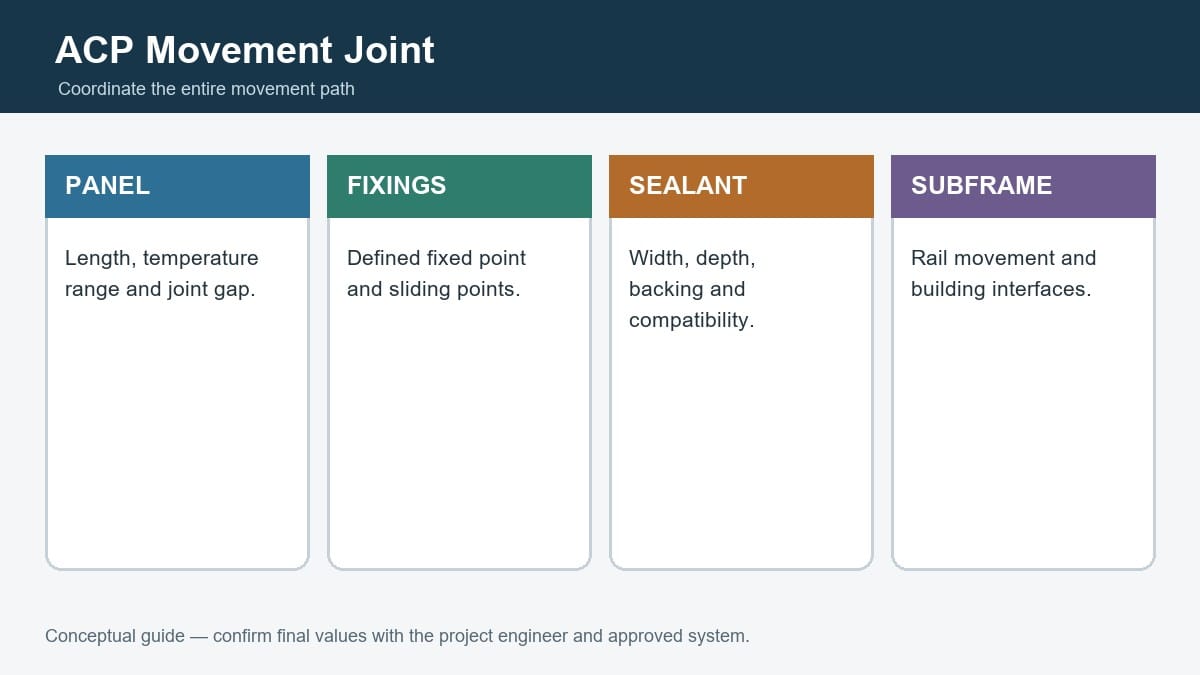
Inputs needed before sizing a joint
| Input | Why it matters | Who confirms it |
|---|---|---|
| Panel and rail length | Longer aluminum components accumulate more thermal movement | Façade engineer and shop drawings |
| Installation and service temperatures | Defines the realistic temperature range around the installed position | Project design team |
| Fixed and sliding points | Controls the direction in which movement is released | System engineer |
| Fabrication and site tolerance | Uses part of the available joint before thermal movement occurs | Fabricator and installer |
| Sealant movement rating | Determines allowable extension and compression at the selected geometry | Sealant supplier |
| Building movement | Structural drift or movement joints may exceed panel-only movement | Structural and façade engineers |
Fixed points establish the movement origin
A panel or rail usually needs a defined locating point. Other attachments then accommodate movement relative to it. If every fastener clamps a nominal movement slot, the system behaves as if it were fixed everywhere. If nothing locates the component, alignment and load transfer become uncertain. Drawings must distinguish these functions.
Joint width is not only thermal expansion
The design allowance includes fabrication tolerance, subframe variation, installation position, sealant application tolerance and expected movement. A gap that is theoretically sufficient for thermal expansion may still close when cassettes are produced at the large end of tolerance and installed against an out-of-position rail.
Sealant geometry and compatibility
Where a wet-sealed joint is used, backing material controls depth and prevents three-sided adhesion. Primer, cleaner and sealant must be compatible with the actual coating and adjacent materials. The sealant supplier should confirm joint dimensions, movement capability, adhesion preparation and staining risk. A thicker bead is not automatically a better movement joint.
Open joints require drainage logic
Rainscreen joints may be intentionally open, but water management then moves behind the visible face. Baffles, flashings, cavity drainage, ventilation and compartmentation must be coordinated. An open joint should not be described as waterproof by itself. The wall assembly manages water through multiple layers.
Failure patterns that reveal restraint
| Symptom | Possible cause | Check first |
|---|---|---|
| Joint closes in hot conditions | Insufficient allowance or wrong movement origin | Temperatures, fixed points and installed gap records |
| Sealant tears at one edge | Adhesion, geometry or movement exceeds capability | Surface preparation, bead shape and product approval |
| Panel bows near fasteners | Slots clamped or bracket lacks adjustment | Fastener torque, washer and slot orientation |
| Joint width drifts across elevation | Accumulated datum or subframe error | Survey control and installation sequence |
| Water appears behind open joint | Not necessarily a defect by itself | Cavity drainage, flashings and inner air/water barrier |
Drawing and RFQ checklist
- Panel modules, returns and joint centerlines.
- Design temperatures and movement calculation basis.
- Fixed points, sliding points, holes and slots.
- Subframe material, rail lengths and structural movement interfaces.
- Sealant, backing rod, primer and tested coating compatibility.
- Open-joint drainage and fire-stopping coordination.
- Fabrication, survey and installation tolerances.
- Mock-up and inspection requirements.
Use a project-specific movement calculation
Alcadex can provide panel construction, coating and fabrication information, but final joint sizing belongs to the project system design. A robust detail documents the assumptions and keeps the movement path continuous through the panel, attachment, rail and building interface. That is more reliable than applying one remembered gap to every elevation.
Installation temperature changes the available movement
A joint installed near the cold end of its service range begins relatively open and may compress as temperatures rise. A joint installed when components are hot may later open further in cold conditions. The calculation should relate the nominal drawing gap to a defined reference temperature and give installers a practical allowable range. Recording representative installation temperatures and gaps helps resolve later questions.
Surface temperature can differ from air temperature, especially on dark panels in direct sun. Project engineers should use an appropriate design basis rather than a convenient weather-app reading. Local climate, orientation, shading and internal conditions all influence the range.
Transitions and building movement joints
Façade panel joints cannot bridge a structural movement joint as if it were a normal module joint. The outer cladding, subframe, membranes, flashings, insulation and fire barriers must all accommodate the expected movement. Similar care is required where ACP meets glazing, masonry, roofing, louvers or different cladding materials with different expansion behavior.
At corners, movement directions interact. A return or bracket that works on a flat elevation may lock the panel at an inside or outside corner. Three-dimensional details and a physical mock-up can expose these conflicts before production.
Frequently asked questions
Is a 10mm joint always enough for ACP?
No. The required nominal gap depends on calculated movement, tolerances, sealant geometry and system details.
Can sealant absorb any amount of movement?
No. Each approved sealant has movement capability and geometry limits. Adhesion and substrate compatibility also matter.
Do open joints eliminate thermal-movement design?
No. The visible gap may remain open, but panels, clips and rails still expand and contract.
Should every fixing use a slot?
No. A stable load path normally requires defined locating and movement points. The engineer specifies their arrangement.