

14 Aug ACP Cassette Systems: Returns, Fixings and Design Checks
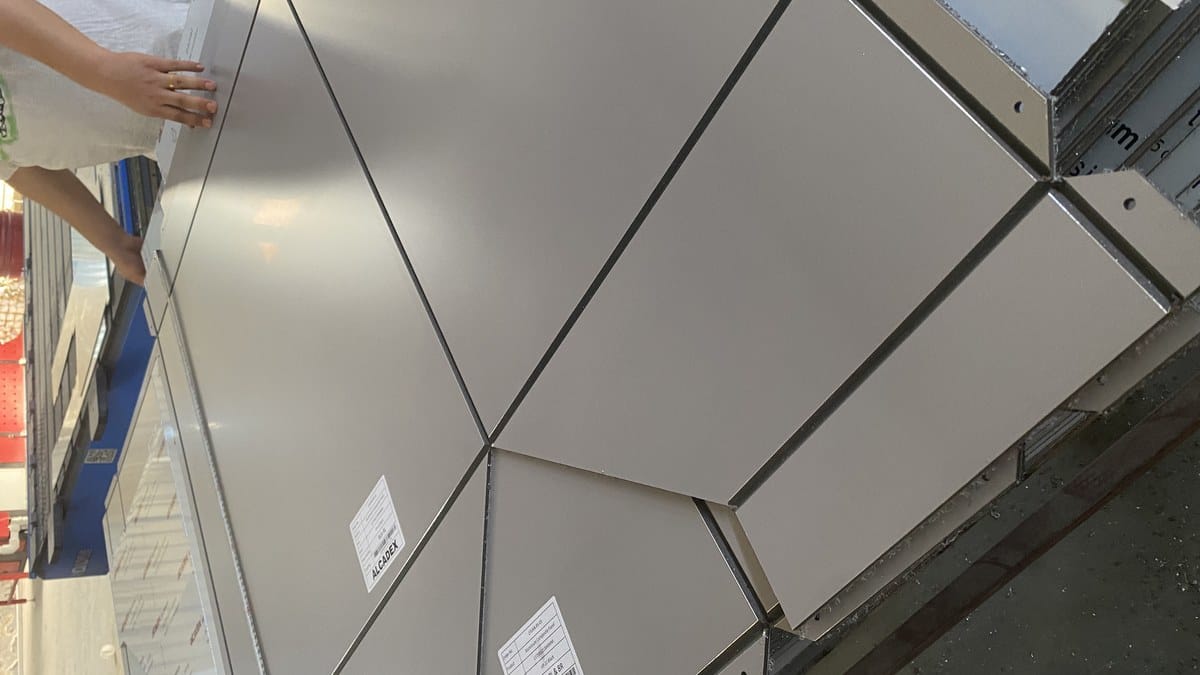
An ACP cassette system uses routed and folded aluminum composite panels with perimeter returns that connect to brackets, clips or rails behind the visible face. The returns create a tray-like component, but the façade performance comes from the complete assembly: panel construction, groove and corner details, stiffeners, attachments, subframe, joints, drainage and engineering.
Buyers should therefore avoid ordering “4mm cassettes” as if thickness alone defines the system. Alcadex needs approved geometry and performance inputs to fabricate parts that match the installation design.
ACP cassette system anatomy
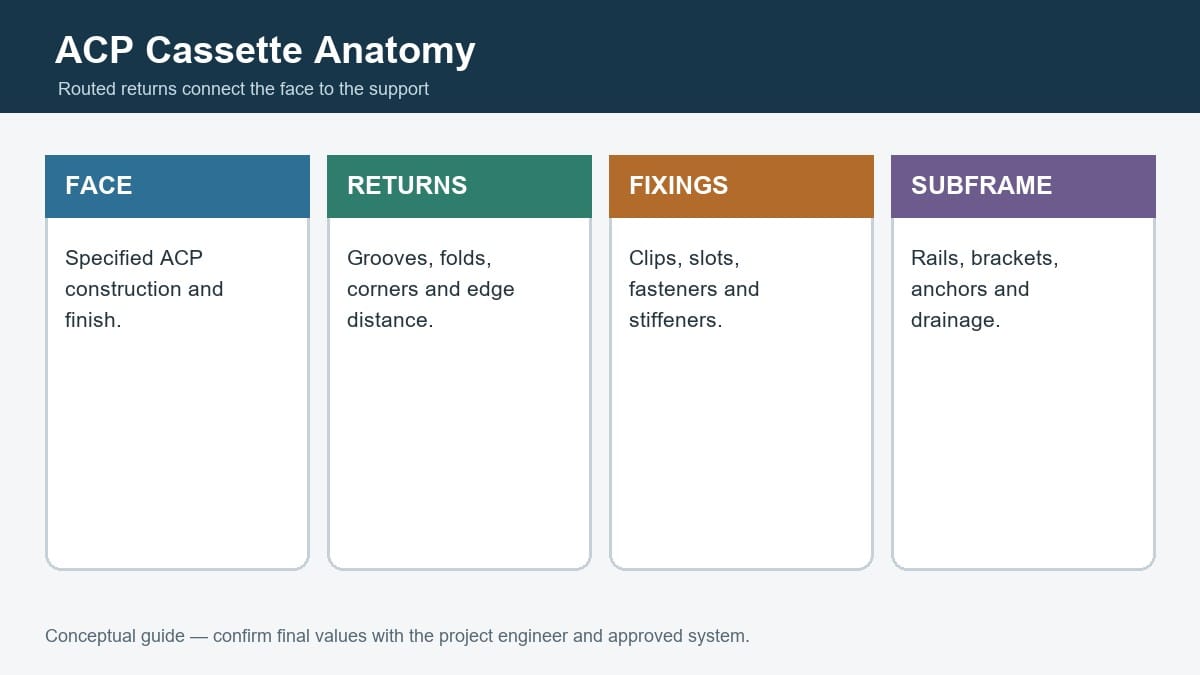
| Component | Function | Design check |
|---|---|---|
| ACP face | Provides the visible coated surface | Construction, finish, span and service environment |
| Routed return | Creates cassette depth and attachment zone | Groove, residual material, fold and edge distance |
| Corner closure | Stabilizes corners and controls geometry | Fastener, reinforcement and corrosion compatibility |
| Stiffener | Supports face where required by span and load | Section, adhesive, preparation and load transfer |
| Bracket or clip | Connects cassette to rail and permits adjustment | Capacity, movement, access and tolerances |
| Rail and bracket | Transfers load to the building structure | Alignment, anchors, thermal breaks and engineering |
Returns convert a sheet into a component
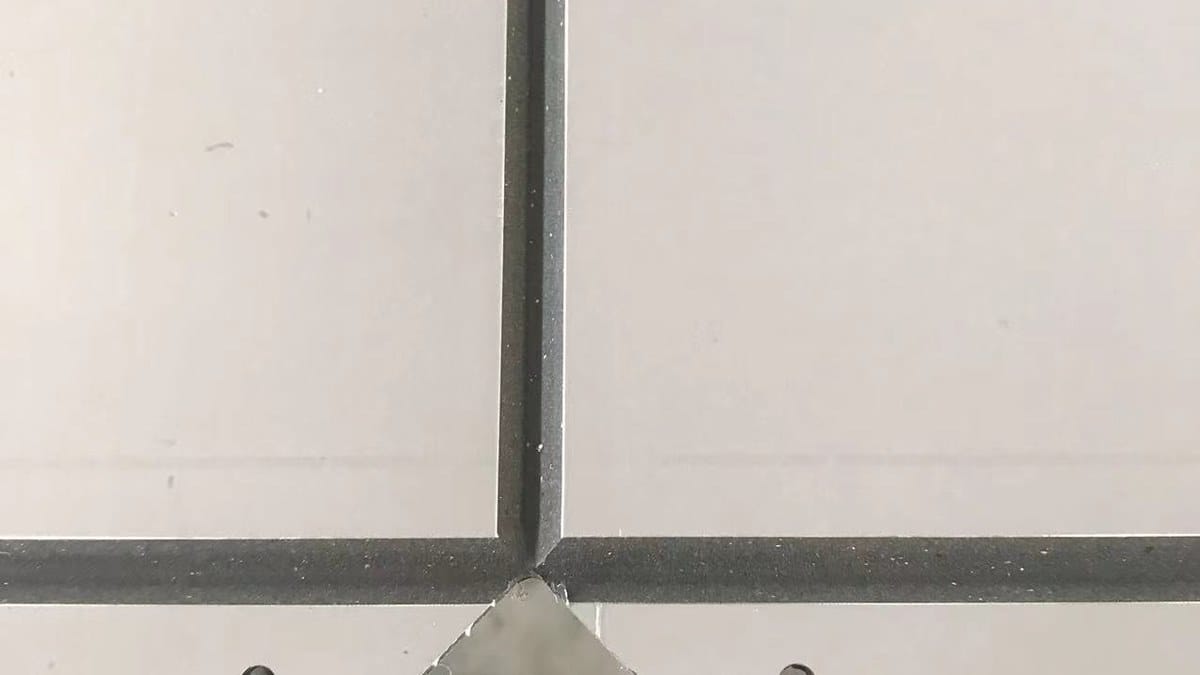
The flat blank is routed along fold lines and corner notches, then formed to the specified depth. Return geometry affects cassette stiffness, bracket position, joint depth and installation access. Small changes can shift the visible joint or conflict with fasteners, so the finished cassette dimensions should control first-off approval.
Fixings need a defined load path
Wind pressure and suction act on the face, then travel through skins, core, returns or stiffeners, clips, rails, brackets and anchors. Each interface must be designed. A concealed clip improves appearance but does not remove the need for edge-distance, bearing, fastener and movement checks.
Stiffeners are not a universal repair
Stiffeners can support large faces or control deflection, but their section, spacing and adhesive bond require design. Surface preparation, adhesive thickness, cure conditions and compatibility with the panel back must be controlled. Adding a stiffener after oil canning appears does not automatically remove residual stress or subframe misalignment.
Joints define appearance and weather strategy
Cassette joints may be wet sealed or open as part of a drained and ventilated rainscreen. Wet joints require correct sealant geometry and coating compatibility. Open joints require a continuous drainage and air/water control strategy behind them. In both cases, module tolerance and thermal movement must be coordinated.
Fabrication and installation responsibilities
| Decision | Typical lead responsibility | Required coordination |
|---|---|---|
| Panel construction and finish | Specifier and buyer | Environment, fire requirement, appearance and warranty |
| Cassette geometry | Façade designer/fabricator | Module, returns, joints and nesting |
| Wind and attachment design | Qualified project engineer | Panel, stiffeners, clips, rails and anchors |
| Fabrication process | Alcadex/fabricator | Approved drawings, first-off checks and traceability |
| Subframe survey and installation | Façade contractor | Datum, adjustment, movement and access |
| Weather and fire interfaces | Project design team | Membranes, drainage, barriers and penetrations |
Design checks before release
- Confirm total thickness, aluminum skins, core and coating.
- Freeze elevation modules, joint centers and finish direction.
- Engineer wind loads, spans, stiffeners and attachments.
- Coordinate fixed points, slots and thermal movement.
- Resolve corners, openings, parapets, bases and penetrations.
- Approve a representative mock-up and first-off cassette.
- Define inspection, labeling, packing and installation sequence.
What Alcadex needs for an accurate quotation
Send elevation and fabrication drawings, quantities by size, return depths, cut-outs, holes, finish direction, panel construction, coating, color, fire requirement, tolerances, stiffeners or brackets in scope, packing sequence and destination. State whether pricing is for flat sheets, fabricated blanks, folded cassettes or a broader component package. Clear scope prevents a low quote from omitting the work that makes the parts installation-ready.
Select the system before finalizing the panel
ACP is one component within a cassette façade. The best result comes when product, fabrication and engineering decisions develop together. Alcadex can support panel selection and controlled fabrication, while the project engineer and façade team confirm system loads, movement, drainage and building interfaces.
From elevation drawing to fabrication drawing
An architectural elevation establishes visible modules and alignment, but it usually does not contain enough information to manufacture cassettes. Fabrication drawings add flat blank geometry, groove centerlines, return depths, corner notches, hole coordinates, brackets, stiffeners, finish direction, part codes and tolerances. Each revision must remain linked to the nesting and production record.
Datum strategy is especially important on large elevations. If every part is dimensioned from a different reference, small variations accumulate and joints drift. A coordinated grid, survey points and consistent part datums allow the factory and installer to speak the same dimensional language.
Prototype and performance validation
A visual mock-up confirms color, gloss, joint rhythm, corners and workmanship. A performance mock-up may also test air, water, structural or movement behavior under a defined standard. These are different objectives, and the contract should state which is required. The tested configuration must represent the proposed panel construction, attachments, subframe and interfaces; changing a critical component afterward may invalidate the comparison.
The first production cassette is another control point. It verifies that the released drawing can be routed, folded, assembled and measured repeatably. It should not be confused with full system performance testing, but it prevents a geometric error from being multiplied across a batch.
Frequently asked questions
Is every folded ACP tray a cassette system?
A tray is a fabricated component. A cassette system additionally defines how that component connects, moves, drains and transfers load within the façade.
Can cassettes be supplied with brackets already attached?
Yes when scope, attachment, packing and installation sequence are agreed. Preassembly can improve control but may increase shipping volume and damage risk.
Are stiffeners always required?
No universal rule applies. Their need depends on panel size, construction, load, deflection criteria and support arrangement.
Who approves cassette engineering?
A qualified project engineer should approve the complete system. Product and fabrication information from Alcadex supports that design but does not replace it.