

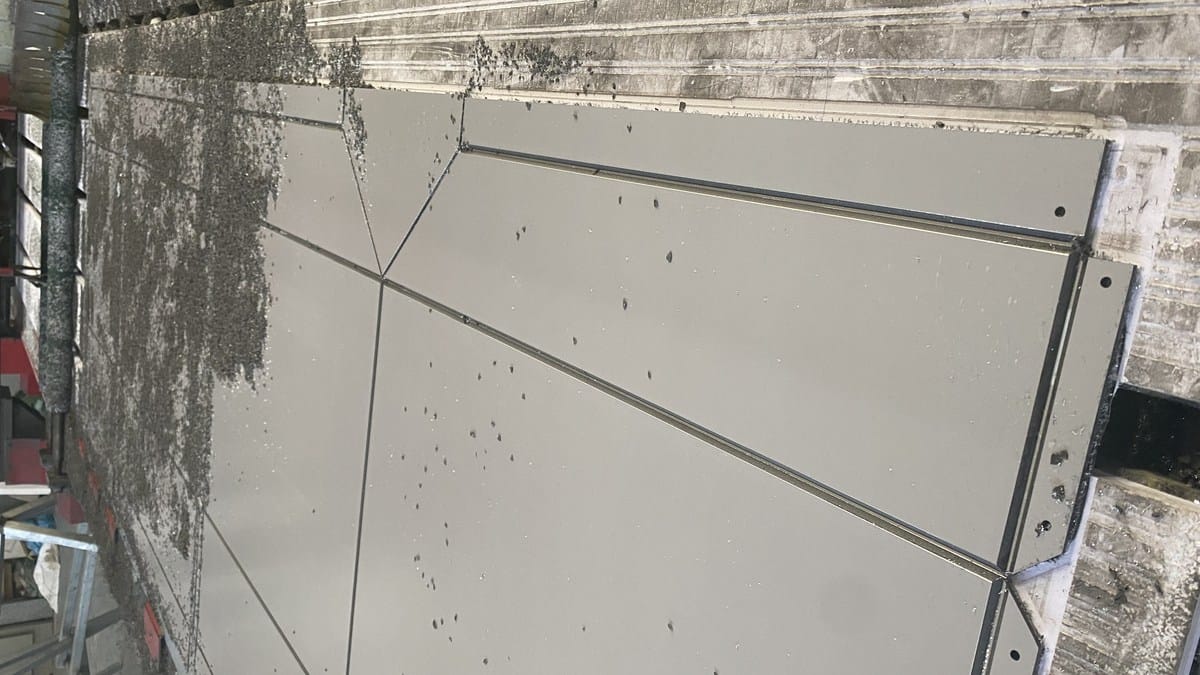
18 Aug ACP Fasteners: Rivets, Screws and Concealed Clips
Rivets, screws and concealed clips can all connect ACP components, but they are not interchangeable. The right choice depends on the load path, access, appearance, supporting metal, movement strategy, inspection method and whether the fastener is intended to locate, clamp or permit sliding.
Alcadex fabricates panels to approved drawings; the project engineer and façade system designer must define the attachment arrangement. Buyers should compare systems on complete details rather than on fastener price alone.
Rivets, screws and concealed clips compared
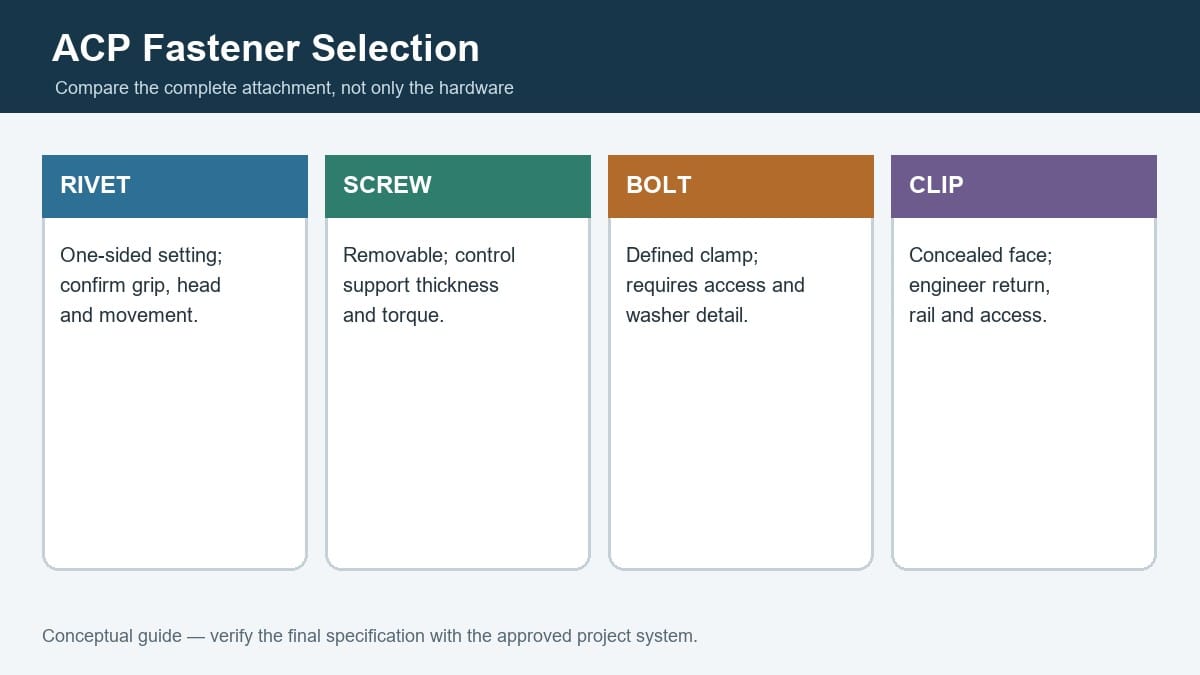
| Option | Main advantage | Main limitation | Typical control |
|---|---|---|---|
| Blind rivet | Fast one-sided installation and repeatable appearance | Grip range, setting force and replacement access need control | Approved rivet, nosepiece, hole and setting check |
| Self-drilling screw | Simple removable connection to suitable metal support | Torque, support thickness and thread stripping can vary | Specified screw, support, driver setting and washer |
| Bolt and washer | Defined clamping and larger bearing area | Requires rear access and can over-clamp movement slots | Washer, torque, locking and clearance detail |
| Concealed clip | Clean visible face and installation adjustment | More components and a less visible load path | Engineered bracket, return, rail and access sequence |
Start with the load path
Wind and service loads act on the panel face and must travel through the aluminum skins, core, folded returns or stiffeners, fasteners, clips, rails, brackets and structural anchors. A strong screw cannot compensate for a weak return, insufficient edge distance or an unverified rail. Every interface must have a defined role and capacity.
Fixed points and movement points
Aluminum expands and contracts with temperature. A system normally needs a defined locating point plus attachments that accommodate movement in controlled directions. Slots work only when oriented correctly and not clamped so tightly that sliding becomes impossible. Random oversized holes do not constitute a movement design.
Visible versus concealed attachment
Face rivets and screws simplify inspection because the head remains visible, but color matching and layout affect appearance. Concealed clips protect the visible face, yet they require accurate returns, bracket positions and installation access. The choice should be made during system design, not after panels arrive on site.

Material compatibility
Fastener alloy, coating, bracket metal and the exposure environment influence corrosion risk. Dissimilar metals may require isolation. Sealants, washers and cleaners also need compatibility with the panel coating. Coastal and industrial environments deserve specific review rather than a generic “stainless” or “galvanized” note.
Selection matrix for buyers
| Question | Why it matters | Evidence to request |
|---|---|---|
| Is rear access available? | Changes whether bolts or some clips can be installed and replaced | Installation sequence and access drawing |
| Must the face be fastener-free? | May justify a concealed cassette arrangement | Approved elevation and joint mock-up |
| Where is movement released? | Controls hole shape, slot direction and clamping | Fixed/sliding point diagram |
| What supports the fastener? | Thread engagement and bearing depend on actual support | Rail material, thickness and test/design data |
| How is quality checked? | Torque, rivet setting and clip engagement require different controls | Inspection method and sampling plan |
RFQ checklist
- Panel construction, return geometry and finish.
- Design loads, spans and service environment.
- Fastener material, diameter, head, grip or thread requirements.
- Hole and slot coordinates from a controlled datum.
- Fixed points, movement points and installation tolerances.
- Corrosion isolation, sealing and replacement access.
- Required tests, calculations and inspection records.
The lowest-cost fastener is not necessarily the lowest-cost system. A coordinated attachment reduces site drilling, alignment corrections, surface damage and uncertain load transfer.
Installation quality controls
Fastener performance depends on installation consistency. Rivets should be set with the approved nosepiece and checked for proper seating without crushing the return. Screws need a controlled driver setting and a support thick enough for reliable engagement. Bolts need an agreed torque or tightening method. Concealed clips require a positive engagement check before the next panel hides access.
A first-off installation is useful for repeated modules. It confirms hole alignment, access, tool clearance, panel adjustment and the visible result. The inspection plan can then identify which features are checked on every panel and which are sampled. A process that records only the fastener count does not confirm correct grip, torque, slot function or clip engagement.
Replacement and maintenance access
Façades and interior linings may require future panel replacement. Face screws can be accessible but visually prominent. Rivets can be drilled out, although removal must not enlarge the supporting hole or damage adjacent coating. Concealed cassette systems can provide a clean face but may require a planned sequence to release a single panel. The design should demonstrate that expected maintenance is possible without dismantling a large area unnecessarily.
Replacement hardware must match the original material, geometry and capacity. Substituting a similar-looking screw or rivet on site can change grip, corrosion compatibility or head coverage. Spare fasteners and documented specifications reduce this risk.
Frequently asked questions
Are stainless steel fasteners always the best choice?
No. Grade, environment, adjacent metals, isolation and the approved system all matter. “Stainless” alone is not a complete specification.
Can one slot accommodate both installation tolerance and thermal movement?
Possibly, but the design must account for the initial installed position, required movement, head coverage and edge distance. The engineer should document the allowance.
Should rivets or screws be color matched?
Where heads remain visible, color and gloss can be coordinated with the panel. The applied finish must also withstand setting or driving without unacceptable damage.
Can concealed clips eliminate sealant joints?
No. Clip choice and weather-joint strategy are separate decisions. Open joints require drainage and air/water control behind the face; wet joints require compatible sealant geometry.