
03 Aug ACP Flatness and Oil Canning: Causes and Controls
ACP oil canning is visible waviness in a nominally flat panel surface, often most noticeable under grazing light or in reflective finishes. It may be an appearance issue rather than evidence of immediate structural failure, but it should never be dismissed without checking panel construction, cassette geometry, support alignment, fixing restraint and the agreed visual acceptance method.
Because reflections amplify small deviations, flatness has to be managed across the full system. A premium panel installed on a twisted subframe can look poor; a well-aligned frame cannot correct a damaged or badly fabricated cassette.
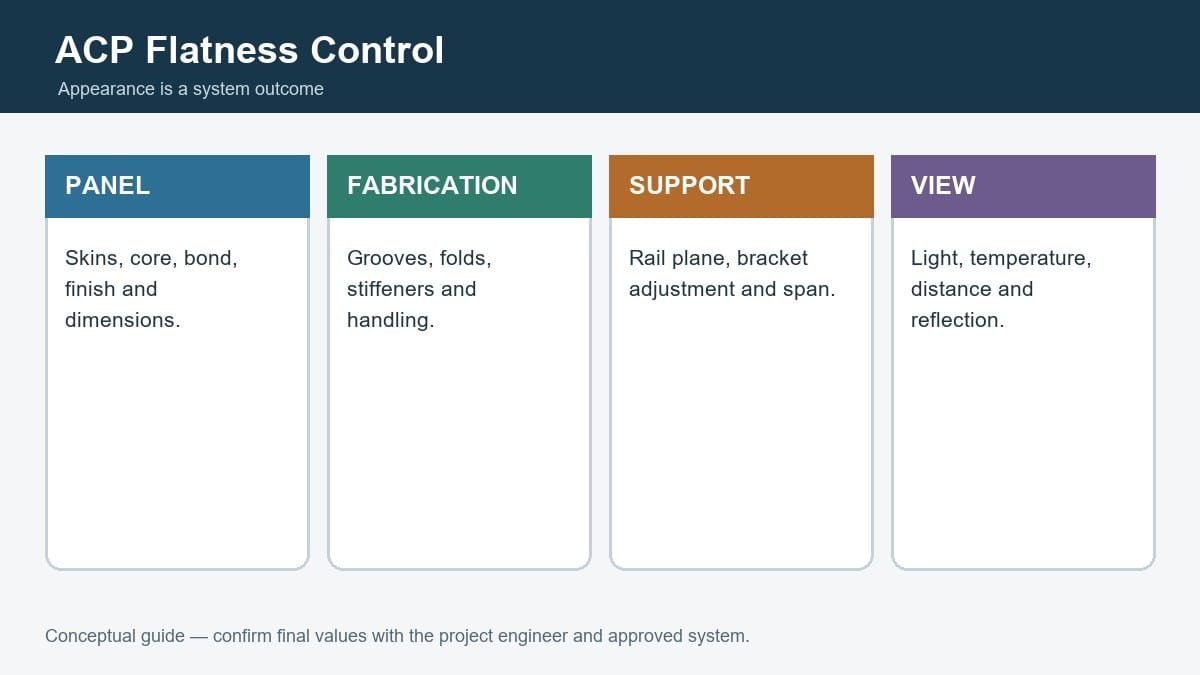
Where apparent waviness comes from
| Source | Examples | Control point |
|---|---|---|
| Panel construction | Skin gauge, core uniformity, bond and residual stress | Approved specification, production controls and incoming checks |
| Fabrication | Groove depth, fold sequence, stiffener bonding and handling | First-off cassette inspection and protected stacking |
| Subframe | Misaligned rails, bracket variation or excessive span | Survey and rectify the support plane before installation |
| Fixing | Forced fit, uneven clamp force or restrained movement | Follow fixed/sliding point and adjustment details |
| Environment and view | Temperature gradient, low-angle sun and mirror finish | Agree realistic visual review conditions |
Flatness starts with the ordered construction
Total thickness is only one variable. Aluminum skin gauge, core type and uniformity, coating system, panel dimensions and unsupported span influence stiffness and visual behavior. Buyers should compare supplier offers on the same construction. A low price based on thinner skins or an unconfirmed core is not an equal substitution.
Fabrication can introduce distortion
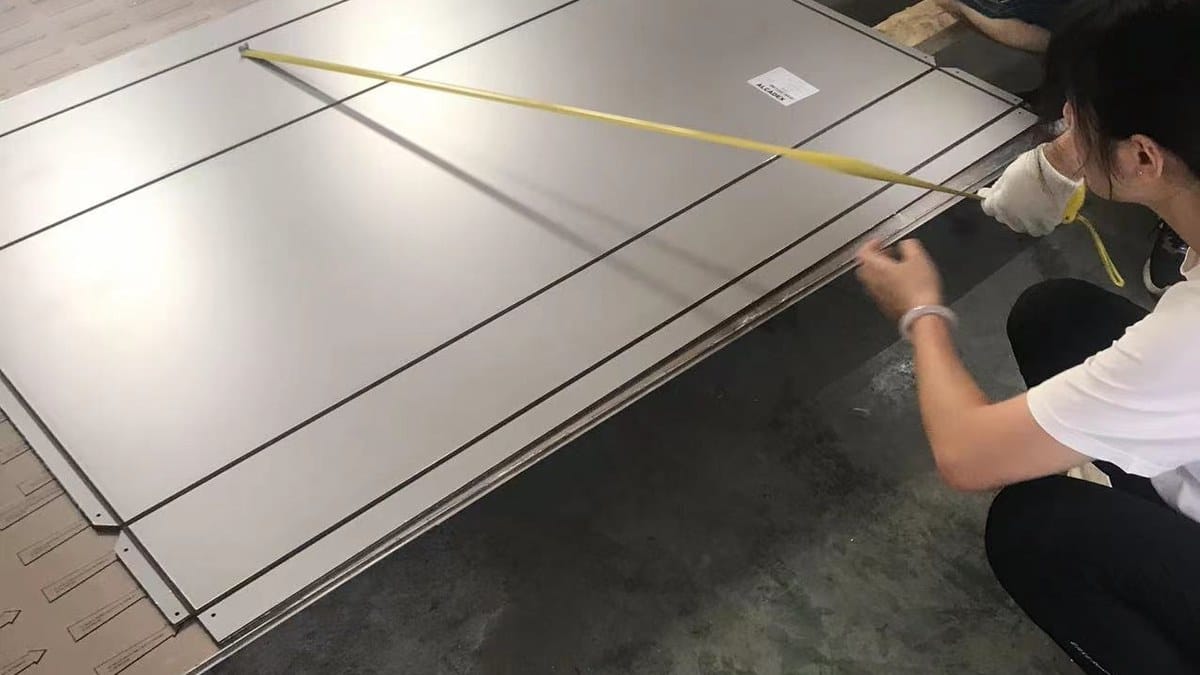
Deep or inconsistent routing, asymmetric returns, poor corner details and uncontrolled stiffener bonding can introduce local stress. Dragging, leaning and point support can deform completed cassettes before they reach site. Alcadex checks the finished fabricated component on suitable support because the flat blank alone does not represent installed geometry.
Subframe plane and forced fit
Rails and brackets should create the plane assumed by the façade design. If installers pull a cassette onto a twisted support, the face can telegraph that distortion. Excessive tightening can also lock in stress. Survey records, adjustment capacity and a defined installation sequence are more effective than trying to correct reflections after sealant and adjacent panels are complete.
Appearance changes with light and distance
A surface may appear acceptable under diffuse light and wavy at sunrise or sunset. Dark, gloss and metallic finishes often reveal reflection changes more strongly than light matte finishes. Therefore a project should agree observation distance, direction and normal lighting conditions in a benchmark mock-up. Close-range inspection under deliberately severe grazing light should not silently become a different acceptance standard.
Oil canning versus a structural concern
| Observation | Initial interpretation | Next check |
|---|---|---|
| Broad shallow waviness only in grazing light | May be mainly visual | Compare mock-up, view conditions and measured plane |
| Local bulge near a fixing | Possible over-clamping or support mismatch | Review fixing torque, bracket and panel return |
| Progressive distortion with temperature | Movement may be restrained | Check slots, fixed points, joints and sealant behavior |
| Debonded sound, blister or growing area | Possible bond or moisture problem | Quarantine and conduct technical investigation |
| Permanent crease or sharp dent | Handling or impact damage | Assess replacement; cosmetic repair is often limited |
A practical control plan
- Freeze the comparable panel construction and finish.
- Approve a representative mock-up under agreed viewing conditions.
- Verify first-off cassette geometry, stiffeners and corners.
- Transport panels with full support, separators and edge protection.
- Survey the subframe plane before closing the façade.
- Install without forcing panels and preserve movement details.
- Record any disputed area before removing or adjusting components.
What to request from Alcadex
Provide panel size, construction, finish, module geometry, design loads, support spacing, cassette details and intended visual standard. Alcadex can then align product selection, fabrication checks, batch control and packing with the risk. The most reliable flatness outcome comes from controlling the system rather than assigning all responsibility to one isolated sheet property.
How to investigate a flatness complaint
Start by preserving evidence. Record panel codes, elevation, date, temperature, sun direction, observation position and whether the condition changes during the day. Photograph the area from the agreed viewing distance and take closer images only to document specific damage. Do not remove fixings before the project team understands how the panel is supported.
Next, compare adjacent modules and the approved mock-up. Survey joint lines and the subframe plane where accessible. Check whether the affected panels share a batch, size, orientation, stiffener pattern or installation crew. These correlations help separate a material issue from a localized support or handling issue. If debonding is suspected, the investigation may require non-destructive checks, controlled removal and laboratory review.
Design decisions that reduce visual risk
Smaller modules, adequate skin gauge, appropriate cassette depth, engineered stiffeners and a well-aligned subframe can improve appearance, but every change affects cost and detailing. Finish selection matters too. Highly reflective dark surfaces reveal distortion more strongly, while patterned or lower-gloss finishes may make minor waviness less conspicuous. This is an architectural choice, not permission to ignore fabrication quality.
Joint layout can interrupt long reflection lines and provide installation adjustment. However, adding joints changes the façade rhythm and weather strategy. The design team should balance module size, visual intent, wind performance, fabrication yield and maintenance before tender.
Frequently asked questions
Is all oil canning a defect?
No single answer applies. Acceptance depends on specification, mock-up, measured condition, viewing criteria and whether performance is affected.
Will thicker ACP always stay perfectly flat?
Greater stiffness may help, but skin gauge, span, temperature, fabrication, support and installation remain important.
Can sealant straighten a wavy panel?
No. Sealant closes or accommodates a joint; it is not a reliable method for correcting the panel plane.
Should panels be inspected with protective film on?
Geometry can be checked with film present, but final surface acceptance requires suitable visibility. Film wrinkles should not be confused with panel waviness.