

11 Aug ACP Scratches and Dents: Prevention and Repair Limits
ACP scratches and dents are surface or shape damage caused by contact, trapped debris, impact, dragging, poor stacking or forced installation. Prevention is more reliable than cosmetic repair because local polishing, filling or touch-up can change color, gloss and reflection and may remain visible.
Alcadex controls damage risk through protective film, clean handling, inspection, separators, edge protection and traceable packing. Final disposition depends on coating damage, dent geometry, location, visibility and whether the panel or bond has been compromised.
Scratch, dent, crease and coating failure
| Condition | Typical appearance | Main concern |
|---|---|---|
| Light surface mark | Transfer or residue without coating penetration | Use only approved cleaning to confirm |
| Scratch | Linear damage across gloss or coating | Color/gloss mismatch and exposed metal if deep |
| Dent | Local shallow depression | Reflection distortion and possible core deformation |
| Crease | Sharp permanent fold or line | Skin and bond damage; replacement is often appropriate |
| Blister/delamination | Raised or hollow area not linked to impact | Possible bond failure requiring investigation |
Where damage begins
Common sources include metal chips under sheets, dirty gloves, hard forklift contacts, unprotected rack edges, over-tight straps, loose components inside cases and tools placed on finished panels. At site, forced alignment, scaffold contact, cutting debris and premature film removal increase risk.
Inspection before handling continues
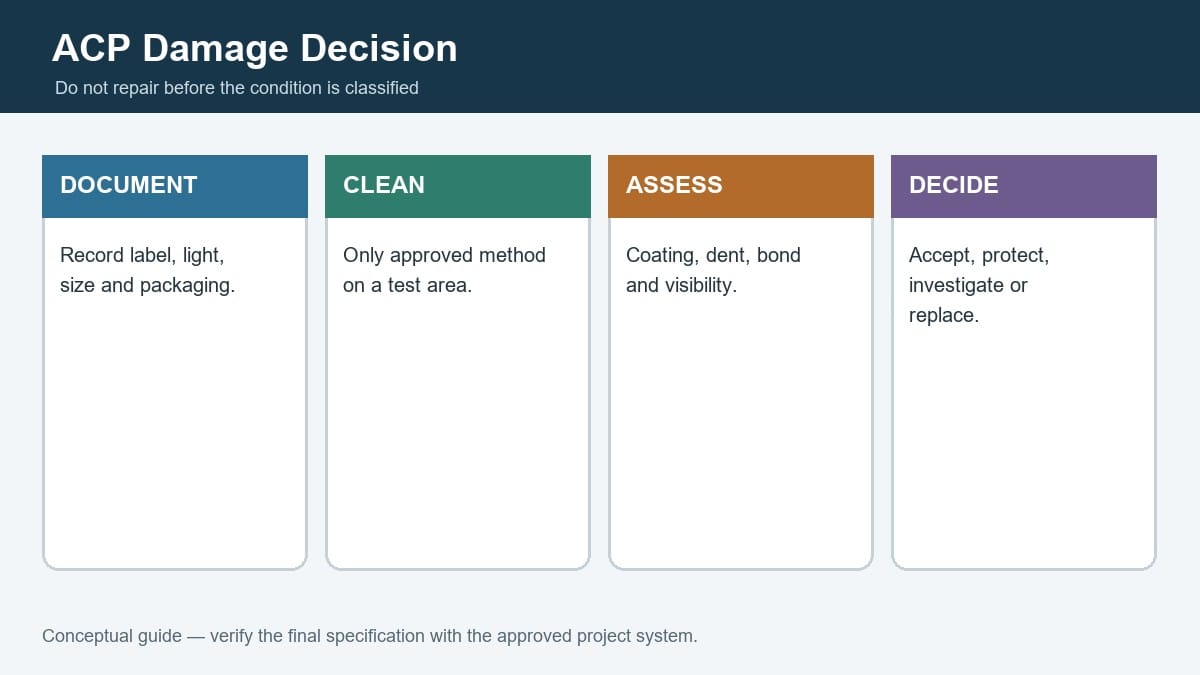
Receiving teams should photograph packaging condition and panel labels before unpacking. Inspect surfaces under consistent light and separate transit damage from installation damage. Keep panel codes, batch and location linked to each observation. Do not remove film from every sheet merely to inspect one sample unless the agreed procedure requires it.
Prevention through packing and site storage
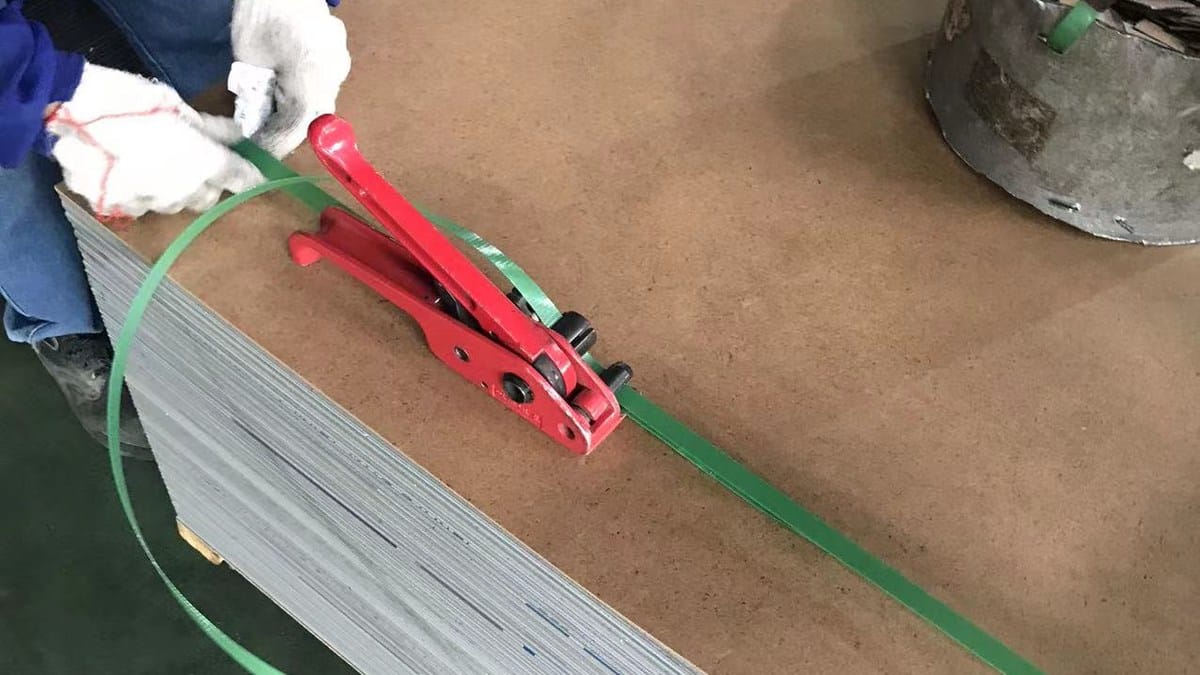
Use flat, stable support; clean compatible separators; protected edges and corners; and straps that restrain without crushing. Keep packs dry and follow storage limits. On site, designate clean cutting and assembly areas. Remove swarf immediately and lift panels rather than dragging them.
Repair limits
A removable residue may need only an approved cleaner. A small concealed-edge mark may be accepted by the project team. Visible-face scratches, creases and dents are harder: touch-up paint can protect exposed metal but rarely reproduces factory color, gloss and texture. Local polishing can create a larger halo. Heating or hammering a composite panel can damage the bond and should not be improvised.
| Finding | Possible disposition | Required control |
|---|---|---|
| Transfer mark only | Approved cleaning | Test on retained sample and inspect afterward |
| Minor concealed-edge scratch | Documented acceptance or approved protection | Project approval and corrosion review |
| Visible coating penetration | Replacement or formally approved touch-up | Coating supplier method and appearance acceptance |
| Dent visible in normal viewing | Usually replace | Mock-up standard and system access review |
| Crease, crack or suspected debond | Quarantine and investigate | Technical assessment before installation |
Claim documentation
- Order, pack, panel and batch identifiers.
- Photos before and after unpacking.
- Damage location, size, lighting and viewing distance.
- Packaging and handling condition.
- Whether protective film and coating are penetrated.
- Installation status and surrounding panel comparison.
- Proposed disposition and approval authority.
A documented decision protects both appearance and traceability. Replacement can cost more initially, but uncontrolled cosmetic work may create a larger and less consistent defect.
Separate manufacturing, transit and site damage
Timing and pattern provide useful evidence. Repeated marks at the same position on multiple sheets may relate to stacking or production handling. Damage concentrated at a case edge may indicate transit movement. Random face scratches near cutting equipment often arise during fabrication or installation. This classification should be evidence-based and should not assign responsibility before packaging, labels and handling records are reviewed.
Retain damaged parts until the parties agree on inspection. Discarding packaging or removing film immediately can eliminate information needed to determine the cause. A retained control sample from the same batch can help distinguish an actual coating issue from deposited material or site contamination.
If a touch-up is proposed, first complete it on a scrap or retained sample with the same color and finish. Review it under the same light and distance used for the installed work. The project owner, architect or defined approval authority should accept the result in writing. A repair that prevents corrosion can still be visually unacceptable on a prominent module.
Repair access also matters. Working on an installed panel may contaminate sealant, glass or adjacent finishes. Removing a panel can damage clips or joints if replacement was not designed. The method statement should address protection, access, curing and reinspection.
Frequently asked questions
Can protective film prevent dents?
Film mainly protects against light surface contact and contamination. It does not prevent impact or point-load dents.
Can a suction cup pull out an ACP dent?
Uncontrolled pulling can deform skins or the bond and may leave optical distortion. Do not use automotive repair methods without technical approval.
Is a scratch acceptable if it is visible only in grazing light?
Acceptance depends on the project specification, normal viewing conditions, location and approved mock-up—not on one universal rule.
Should every damaged panel be replaced?
No, but visible coating penetration, creases, cracks, suspected debonding and prominent dents generally justify a conservative technical review.