

03 Aug Why ACP Panels Delaminate and How to Prevent It
ACP panels delaminate when the bond between an aluminum skin and the core loses integrity. The visible result may be a bubble, raised area, loose edge, hollow sound, or complete separation, but the root cause can originate in material manufacture, heat exposure, moisture entry, incompatible processing, impact, or an installation detail that places the panel under unintended stress.
Delamination is different from a surface dent, coating blister, local oil canning, or protective-film residue. Correct diagnosis matters because the remedy for a damaged finish is not the remedy for a failed bond line. When a suspected failure is found, quarantine the affected panels, preserve labels and batch records, photograph the condition, and involve the panel supplier, fabricator, installer, and designer before destructive investigation.
Where delamination happens in an ACP panel
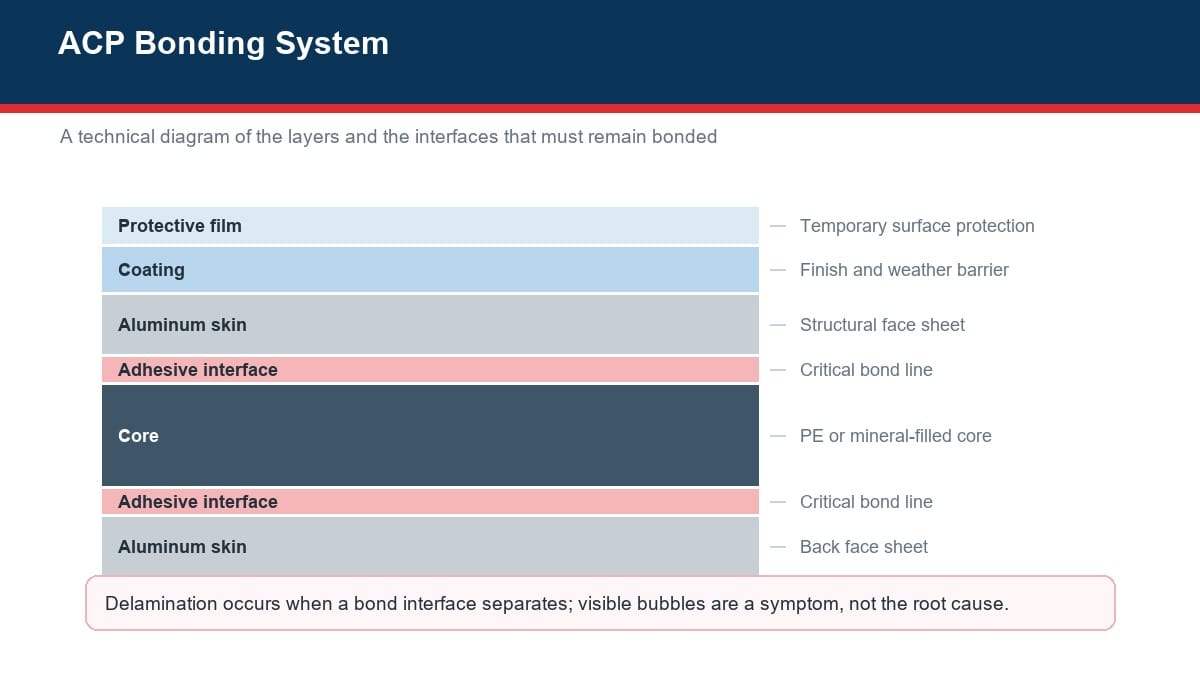
An aluminum composite panel normally has two aluminum skins bonded to a core. Coating and protective film sit outside the structural bond line. Separation can occur between a skin and the core, within a layered core, or locally around a processed edge. A coating defect on top of the aluminum is a different failure and should be investigated separately.
The bond must survive production, transport, storage, cutting, routing, folding, installation, daily temperature cycles, wind pressure, cleaning, and long-term service. A weakness may remain invisible until heat, movement, suction, or water exposure reveals it. That is why both factory process control and project handling records are important.
Common causes and prevention
| Potential cause | Typical evidence | Prevention | Investigation question |
|---|---|---|---|
| Insufficient or uneven bonding | Separation across broad areas or repeated pieces from one batch | Qualified lamination settings, surface preparation and peel-strength control | Do factory test records correlate with the affected batch? |
| Excessive process heat | Localized failure near cutting, routing or forming zones | Validated tools, feed, cooling and groove parameters | Is damage aligned with a fabrication path? |
| Over-deep routing | Weakness or cracking along a fold | Trial folds and residual-material checks using production panels | Does the groove enter or damage the outside skin? |
| Water entry at exposed edges | Edge-related deterioration, staining or freeze-related movement | Project-appropriate edge and joint detailing | Where can water enter, drain and dry? |
| Incompatible adhesive or sealant | Softening, staining or loss near a bonded accessory | Written compatibility confirmation and mock-up testing | What products contacted the skin, core or coating? |
| Forced installation | Stress concentrated at fixings, corners or misaligned subframes | Survey, adjustment zones and movement allowance | Was the panel pulled into plane by the fixings? |
| Impact or handling damage | Local dent with separation around the impact | Edge protection, correct lifting and controlled storage | Was the package or sheet damaged before installation? |
Manufacturing controls that reduce risk
Bond performance begins with clean and properly prepared materials. The aluminum surface, adhesive or bonding film, core, line temperature, pressure, speed, cooling, and curing conditions must work as one qualified process. Changing a skin, core formulation, adhesive system, or line setting without evaluation can change the bond.
Traceability is equally important. A product label should connect the sheet to an order, specification, color, batch, and production record. Sampling and test frequency should follow the supplier’s documented quality plan and any agreed project requirements. Buyers should avoid interpreting a single laboratory value without its method, specimen preparation, test direction, conditioning, and acceptance basis.
Fabrication and installation controls
Fabricators should confirm that the selected panel is suitable for the intended forming process. Make a first-off part, inspect the groove, fold the component, and check the outside face for cracking, read-through, or bond disturbance. Keep cutters sharp and control heat. Do not improvise with solvents, tapes, adhesives, primers, or sealants that have not been checked for compatibility.
Installers should never use panel fixings to correct a severely out-of-plane subframe. The panel system needs defined fixed points, sliding or movement points where applicable, joint clearance, and correct bracket alignment. Tightening that prevents movement can introduce stress as panel temperature changes. Details must also manage water so it does not remain trapped against cut edges or behind the façade.
How to investigate suspected delamination
The following sequence preserves evidence and avoids turning a limited defect into a disputed project-wide claim.
- Stop and identify. Mark affected panels without damaging the finish. Record elevation, panel number, batch label, installation date, weather, and the person who observed the issue.
- Map the pattern. Note whether the condition follows a batch, elevation, sun exposure, joint, edge, fixing, routing line, or handling route.
- Separate look-alike defects. Determine whether the change is in the protective film, coating, aluminum skin, bond line, core, or supporting system.
- Review records. Collect purchase specifications, factory certificates, fabrication drawings, tool settings, delivery inspections, installation photos, sealant data, and cleaning records.
- Agree on sampling. The responsible parties should approve specimen locations and chain of custody before panels are removed or cut.
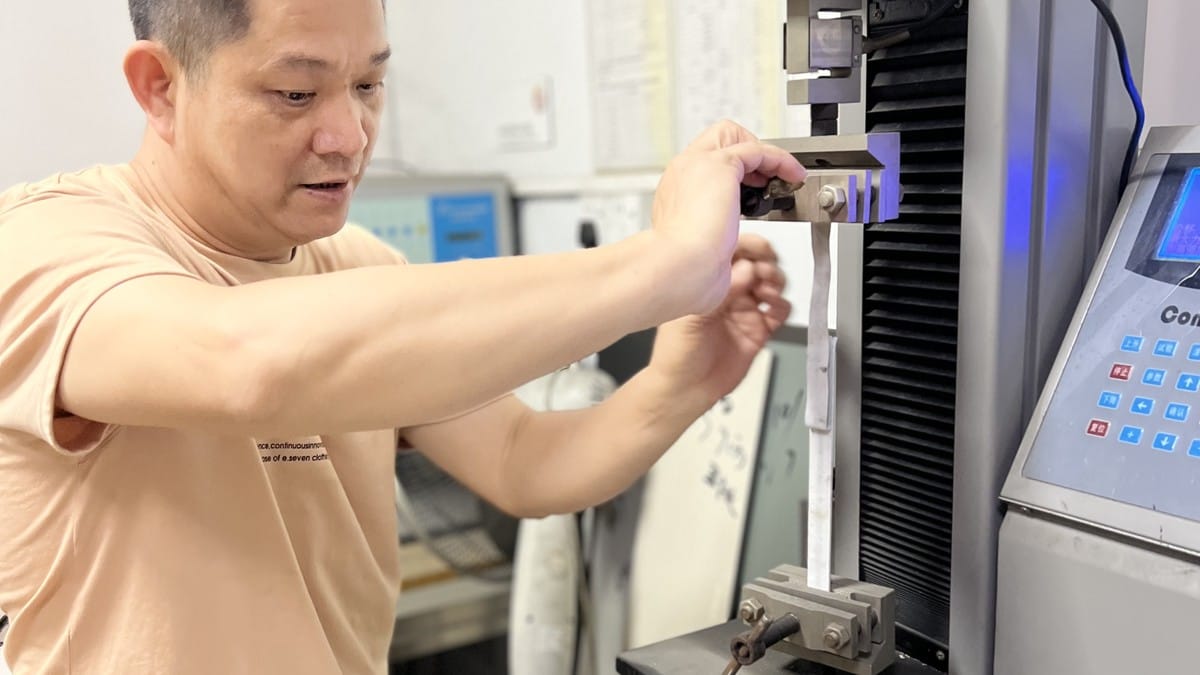
- Test against an agreed basis. Compare affected, adjacent, retained, and control samples using a defined method. Record failure mode as well as force.
- Decide corrective scope. Repair, replacement, monitoring, and root-cause actions should follow the evidence, not only the most visible symptom.
Diagnosis checklist
| Observation | May indicate | Evidence to collect |
|---|---|---|
| Loose edge after routing | Process damage, poor original bond, or edge impact | Groove photos, tool settings, retained offcuts and batch data |
| Broad bulge in strong sun | Bond separation, restrained movement, trapped pressure or flatness issue | Temperature, fixing detail, sound survey and cross-section |
| Repeated failures from one shipment | Batch or transport-related problem | Package IDs, production lots and receiving photos |
| Failure around added stiffeners | Adhesive compatibility, preparation or stress concentration | Adhesive data, cure record, pull test and layout |
| Surface blister with intact bond | Coating or contamination issue rather than panel delamination | Coating cross-section and supplier review |
Frequently asked questions
Can a delaminated ACP panel be repaired on the wall?
A cosmetic site repair is not automatically a structural repair. The cause, area, panel function, fire and weather requirements, and accessibility must be evaluated by the responsible designer and suppliers. Replacement is often more defensible when bond integrity is uncertain.
Does a hollow sound prove delamination?
No. Sounding can help map differences, but it is a screening method. Panel geometry, supports, cavities and fixings also affect sound. Confirmation may require comparison samples and an agreed destructive or non-destructive method.
Is every bubble a manufacturing defect?
No. A bubble-like appearance can result from coating, film, restrained movement, local heat, impact or bond separation. Manufacturing is one possible source, not the only one.
Final takeaway
Preventing ACP delamination requires control across the entire chain: qualified manufacture, traceable testing, appropriate panel selection, validated routing and folding, compatible accessories, dry and protected storage, aligned installation, and evidence-based investigation. If a defect appears, preserve the batch and process information before removing panels.
For panel construction, samples, quality documentation, or project-specific guidance, review Alcadex aluminum composite panels or send the Alcadex team your specification and application details.