02 Jul What Is ACM Material? Panels, Uses and Specifications
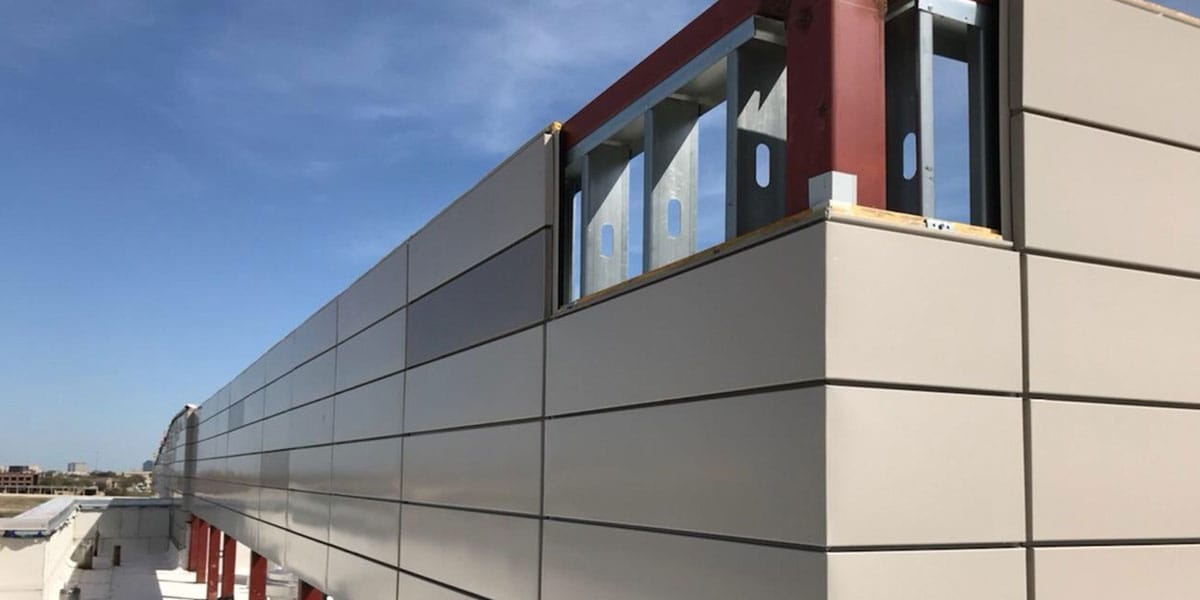
ACM material (aluminum composite material) is a flat panel made by bonding two thin aluminum skins to a non-aluminum core. The finished sheet is commonly called an ACM panel or an aluminum composite panel. Its performance depends on the complete construction—total thickness, aluminum skin thickness, core, bonding, coating, finish and intended application—not on the acronym alone.
ACM is used for architectural cladding, interior walls, ceilings, signs, displays and fabricated components because the layered construction can provide a flat surface with less aluminum than a solid sheet of similar overall thickness. However, buyers should compare written specifications rather than assuming every ACM panel has the same properties.
What Does ACM Mean?
ACM stands for aluminum composite material. It normally consists of two aluminum face sheets bonded to a central core. Depending on the product family and intended use, the core may be polyethylene or a mineral-filled formulation. The exposed aluminum face can receive a coating, color or decorative finish, while the reverse face may use a service coating specified for the panel construction.
The words used by suppliers vary by market. The following terms overlap, but they are not a complete product specification.
| Term | Typical meaning | What the term does not confirm |
|---|---|---|
| ACM | Aluminum composite material | Core, skin thickness, coating, dimensions or fire-performance evidence |
| ACM panel | A finished panel made from aluminum composite material | Whether it is intended for signage, interiors, façades or another application |
| ACP | Aluminum composite panel; commonly used as a product-category term | The complete panel construction or applicable test report |
| MCM | Metal composite material; a broader category that can include metals other than aluminum | That the face metal is aluminum |
For a broader introduction to the category, see the Alcadex guide to aluminium composite panels. Buyers comparing actual products should move beyond terminology and record the complete specification.
How Is an ACM Panel Built?
An ACM panel is a bonded assembly. The two metal skins provide the visible surfaces, the core separates the skins and contributes to the panel’s overall thickness, and the bonding layers keep the construction working as one sheet. Coatings and finishes protect or decorate the exposed surface. Protective film may be applied for handling and removed at the appropriate stage after fabrication or installation.
| Panel element | Primary role | Buyer check |
|---|---|---|
| Front aluminum skin | Provides the exposed metal surface and carries the specified coating or finish | Alloy or temper where required, skin thickness, pretreatment, coating and color reference |
| Core | Separates the skins and affects weight, fabrication and the documented fire-performance option | Core type, required classification, test method and matching report scope |
| Rear aluminum skin | Completes the composite structure and supports panel balance | Skin thickness and rear-side coating or service finish |
| Bonding layers | Join the aluminum skins and core into one panel | Supplier quality controls and order-specific inspection requirements |
| Coating or decorative finish | Defines appearance and surface suitability for the intended environment | Coating system, color, gloss, grain direction, approved sample and exposure |
Total panel thickness and aluminum skin thickness are different measurements. A “4 mm ACM panel,” for example, identifies the overall thickness but does not by itself state the thickness of either aluminum face, the core formulation or the coating. Those details must be recorded separately when quotations are compared.
ACM Panels vs Solid Aluminum Panels
ACM panels and solid aluminum panels can both provide metal-faced architectural or fabricated surfaces, but they are not interchangeable. ACM uses thin aluminum skins separated by a core. A solid aluminum panel or plate uses aluminum throughout its thickness. The better choice depends on the application, engineering, fire strategy, forming requirements, support system and project documentation.
| Comparison | ACM panel | Solid aluminum panel or plate |
|---|---|---|
| Construction | Two aluminum skins bonded to a non-aluminum core | Aluminum through the full material thickness |
| Specification | Must state total thickness, each skin, core, bond and coating | Usually focuses on alloy, temper, metal thickness and finish |
| Flatness and stiffness | Composite construction supports a flat sheet at relatively low weight | Depends strongly on metal thickness, forming and support spacing |
| Fabrication | Can be cut, routed, grooved, drilled and prepared for folding when the panel build permits | Can be cut, bent, welded or formed with processes selected for the alloy and thickness |
| Fire evaluation | Requires review of the exact panel construction and, where applicable, the complete wall assembly | The metal is non-combustible, but coatings, insulation and the complete assembly still require project review |
| Recycling route | Requires separation or processing of the aluminum and core | A single-metal sheet is generally simpler to sort as aluminum |
| Selection basis | Useful where a lightweight, flat, finish-ready panel is required | Useful where the design specifically requires a solid-metal construction |
Neither material is automatically superior. A fair comparison must use the same panel dimensions, design loads, support spacing, finish, fabrication scope and acceptance criteria. Comparing a thin sign-grade ACM sheet with a formed architectural aluminum plate—or comparing only the overall thickness—does not produce a useful purchasing decision.
Where Are ACM Panels Used?
ACM panels serve both construction and visual-communication markets. The same acronym may therefore refer to products with different aluminum skins, coatings, cores and documentation. The application should be defined before the product family is selected.
| Application | Why ACM may be considered | Specification questions |
|---|---|---|
| Façade and wall cladding | Flat modules, fabricated returns and a wide finish range | Exposure, design loads, panel build, fire strategy, subframe, joints, drainage and applicable system evidence |
| Interior walls and partitions | Cleanable finished surface and straightforward panel sizing | Impact risk, finish, cleaning method, edge details and required fire documentation |
| Ceilings, canopies and column covers | Lightweight formed components and coordinated finishes | Geometry, supports, access, wind or service loads, coating and fabrication drawings |
| Signs and displays | Flat printable or film-ready surface with easy cutting and routing | Indoor or outdoor exposure, print method, surface finish, cut size, mounting and edge treatment |
| Factory-fabricated components | Repeatable cutting, routing, grooving, drilling and folded details | Approved drawings, tolerances, groove geometry, quantity, packing and transport protection |
How to Specify ACM Material for a Quotation
A supplier cannot compare or confirm an ACM quotation from the words “ACM panel” alone. Record the following information in one written enquiry so every supplier prices the same scope.
| Quotation item | What to state | Why it matters |
|---|---|---|
| Application and exposure | Façade, interior, ceiling, signage or fabricated part; indoor/outdoor environment | Guides the panel family, coating, finish and documentation review |
| Panel thickness | Required total thickness in millimetres | Affects handling and stiffness but does not replace the skin or core specification |
| Aluminum skins | Thickness of each skin and any alloy/temper requirement | Two panels with the same overall thickness can use different skin constructions |
| Core and fire requirement | Core type, required standard, classification and report basis | Marketing labels are not a substitute for matching product and test evidence |
| Coating and finish | Coating system, color reference, gloss, texture or decorative pattern | Controls appearance and suitability for the intended exposure |
| Size and quantity | Sheet width, length, cut sizes and number of sheets or components | Affects production planning, yield, packing and freight |
| Factory processing | Cutting, routing, grooving, drilling, punching or CNC requirements with drawings | Defines whether the quotation covers full sheets or prepared components |
| Packing and delivery | Packing method, Incoterm, destination and requested timing | Makes supplier totals and delivery scope comparable |
Alcadex groups its ACP and ACM panel range into standard, fire-rated, decorative and specialty families. These families describe different selection criteria, and a quoted panel may combine a coating, core and finish subject to specification review.
Core, Coating and Fire Requirements Are Separate Decisions
The core, coating and fire requirement should not be treated as one option. A coating such as PE or PVDF concerns the metal surface. The core concerns the material between the skins. Fire-performance requirements concern the exact tested or classified construction and, for many building applications, the complete wall assembly.
If a project requires documented fire performance, state the jurisdiction, building use and required standard or classification. Then check that the quoted panel build and the supporting report refer to the same construction. Alcadex provides A2 and B1 fire-rated ACP options, but the required standard, suffix, specimen and report scope must still be confirmed for each project.
ACM Panel Fabrication and Factory Processing
ACM can be processed into full sheets, cut sizes or fabricated components. Feasible operations depend on the panel construction, geometry, tolerance and drawing. Common factory operations include cutting, sizing, routing, V-grooving, drilling, punching and CNC machining.
For processed orders, submit dimensioned drawings and identify finished dimensions, hole locations, groove geometry, returns, grain or coating direction, quantity and packing requirements. Alcadex reviews panel selection and processing feasibility before quotation. See the ACP panel processing and fabrication scope for the available factory services and the information required with drawings.
How to Compare ACM Panel Suppliers
Use one written specification for every supplier. A lower quoted total may reflect thinner aluminum skins, a different core, another coating, standard sheets instead of processed parts, lighter packing or a different delivery term. Compare these differences before comparing price.
- Match the construction: total thickness, front and rear skins, core and bonding.
- Match the surface: coating, color, gloss, texture and approved sample.
- Match the evidence: test standard, specimen, classification and report scope.
- Match the processing: full sheets, cut sizes, grooves, holes, folded components and tolerances.
- Match the commercial basis: quantity, packing, Incoterm, destination, lead time and quotation validity.
This method prevents an apparent price comparison from becoming a comparison of different products and different delivery scopes.
Frequently Asked Questions
Is ACM the same as ACP?
ACM means aluminum composite material, while ACP means aluminum composite panel. In normal industry use, both often refer to the same basic panel category: two aluminum skins bonded to a non-aluminum core. Neither acronym confirms the exact specification.
Is an ACM panel solid aluminum?
No. An ACM panel has aluminum faces and a separate core. A solid aluminum sheet or plate is aluminum through its full thickness. This structural difference affects specification, fabrication, weight, recycling and project evaluation.
What thickness are ACM panels?
ACM panels are produced in different total thicknesses for different applications. The required thickness should be stated together with each aluminum skin thickness, core, coating, sheet size and support conditions. Total thickness alone is not a complete specification.
Can ACM panels be used outdoors?
ACM can be specified for outdoor applications when the panel construction, coating, fabrication, fixing system and supporting evidence suit the exposure and project requirements. A generic ACM label does not confirm outdoor suitability.
Can ACM panels be cut and folded?
Many ACM constructions can be cut, routed, grooved and prepared for folding. The groove depth, remaining skin, return dimensions, tolerances and coating direction should be reviewed against approved drawings before production.
What should I send for an ACM panel quote?
Send the application, panel thickness, aluminum skin thickness, core or fire requirement, coating, color, sheet or finished dimensions, quantity, processing drawings, packing, Incoterm and destination.
Request an ACM Panel Review
Send Alcadex your application, panel build, dimensions, quantity, processing requirements and destination. The team will review the available product family and quotation details.