

31 Aug Honeycomb Aluminum Sheet vs ACP
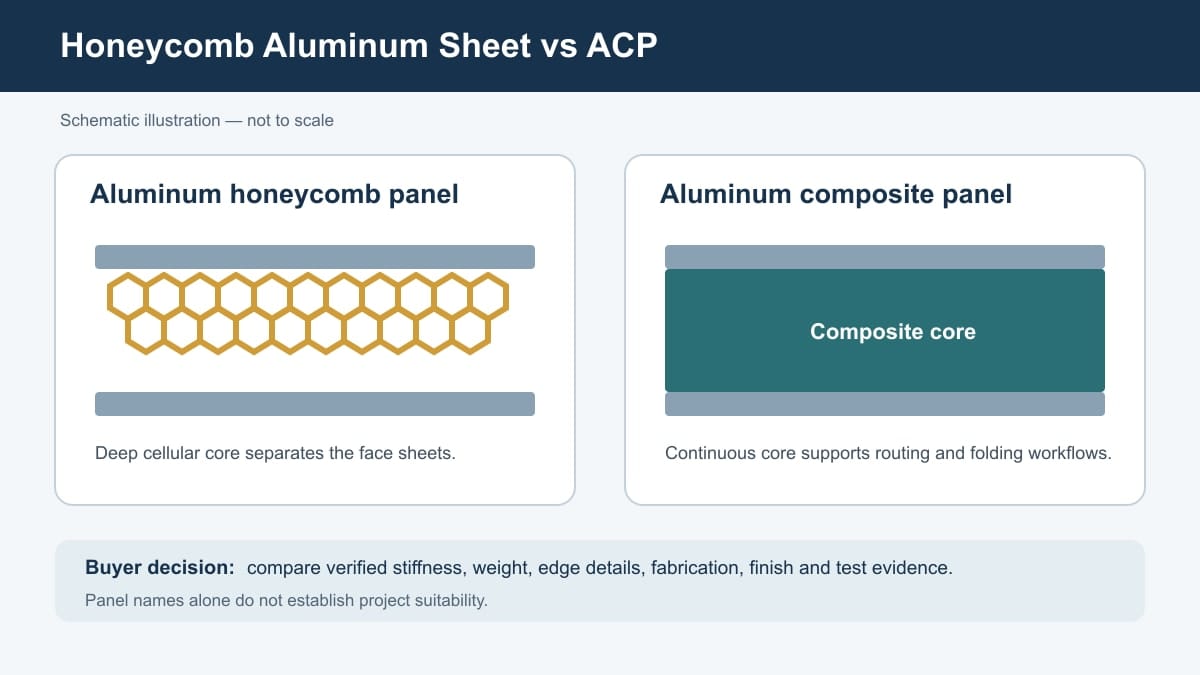
Honeycomb aluminum sheet and aluminum composite panel (ACP) are both lightweight sandwich panels, but they solve different design and fabrication problems. A honeycomb panel uses two aluminum face sheets separated by a cellular aluminum core. ACP normally uses two aluminum skins bonded to a continuous composite core. The honeycomb construction can provide a high stiffness-to-weight ratio at greater panel depths, while ACP is often easier to route, fold, cut and form into common cladding or signage details.
Neither material is automatically the better choice. Buyers should compare the complete panel construction, verified mechanical data, surface finish, edge treatment, fabrication method, fixing system, test evidence and project approval requirements. This guide focuses on those procurement decisions rather than treating the product name as a performance guarantee.
| Decision point | Honeycomb aluminum sheet | ACP |
|---|---|---|
| Core structure | Cellular aluminum core between metal face sheets | Continuous composite core between aluminum skins |
| Typical design reason | High panel depth and stiffness with controlled mass | Thin, flat, finish-ready sheet that supports common routing and folding |
| Fabrication focus | Edge closeouts, inserts, local reinforcement and attachment transfer | Groove depth, fold quality, return dimensions and fastener details |
| Common buying risk | Assuming all honeycomb cells, foils, adhesives and edge details perform alike | Specifying total thickness while ignoring skin thickness, core type and coating |
| Best evidence | Construction drawing, mechanical data, insert details and relevant test reports | Panel construction, skin data, coating system, fabrication drawings and relevant test reports |
How the Two Panel Constructions Differ
The structural idea is similar: place relatively thin face sheets away from the panel center and use a lightweight core to maintain the separation. The important difference is the core geometry and the way loads move through the panel.
Honeycomb aluminum construction
An aluminum honeycomb panel generally combines an aluminum cellular core with aluminum face sheets. Cell geometry, foil gauge, core depth, face-sheet thickness, alloy, adhesive system, edge closeout and inserts all affect the finished panel. A quotation that says only “aluminum honeycomb panel” therefore leaves important engineering and fabrication variables unresolved.
The cellular core provides separation between the face sheets with relatively little material. This can be useful when a designer needs a deeper panel with controlled weight. However, the open cell geometry also means that point loads, fasteners and exposed edges require deliberate detailing. The designer cannot assume that a screw placed anywhere through the face sheet will transfer the required load.
ACP construction
ACP uses two aluminum skins bonded to a continuous core. Core formulation, total panel thickness, aluminum skin thickness and coating specification vary by product. For a clear introduction to the material, see how an ACP panel is constructed.
The continuous core supports familiar sheet-fabrication workflows. Fabricators can cut, route and fold suitable ACP into cassettes or other shapes when the product, tooling and detail allow it. This does not mean every ACP configuration can use the same groove, bend radius or fixing detail. Drawings and first-off checks still matter.
Stiffness, Weight and Panel Depth
“Honeycomb is stronger” and “ACP is lighter” are incomplete statements. Panel stiffness and mass depend on the full construction, not the family name. A deep honeycomb panel may achieve greater bending stiffness than a much thinner ACP sheet, but the result also depends on face-sheet thickness, core properties, bond quality, panel dimensions, support spacing and load direction.
Buyers should request areal mass, meaning weight per unit area, rather than compare one sample by hand. They should also request a stiffness or deflection basis that matches the intended panel size and support condition. Comparing a small laboratory coupon with a full facade cassette does not establish how the installed system will behave.
For large modules, stiffness may influence visual flatness, handling and the number of supports. Yet a stiffer panel is not automatically easier to install. Large panels can be more difficult to transport, lift and align, and their edge connections must still transfer wind, dead load and handling forces.
Fabrication, Edges and Attachments
Fabrication is often where the practical difference becomes most visible. ACP is widely used for routed-and-folded panel work. Honeycomb panels more often rely on designed edge closures, bonded or mechanically integrated frames, local inserts and attachment zones.
ACP fabrication questions
- What groove geometry and remaining core thickness are permitted?
- What minimum return, edge distance and corner treatment are required?
- Will the sheet be supplied flat or as fabricated cassettes?
- Which party is responsible for shop drawings, fabrication tolerances and first-off approval?
The division of work matters. The panel supplier and fabricator have different responsibilities, so the purchase order should identify who verifies tooling, geometry, attachments and finished dimensions.
Honeycomb fabrication questions
- How are exposed cells closed at cut edges?
- Where are inserts, frames or dense local reinforcement required?
- How will fastener loads transfer into the panel?
- Can the supplier provide finished panels, or will another specialist fabricate them?
- How are penetrations and field modifications controlled?
Unplanned field cutting can expose the cellular core or remove a designed attachment zone. For that reason, honeycomb panel dimensions, penetrations and inserts are usually better coordinated before production. A project team should not treat edge closure as a cosmetic afterthought.
Surface Finish and Visual Quality
Both panel families can use coated aluminum faces, but the exact finish range depends on the supplier and product. Buyers should name the coating system, color reference, gloss or texture, approved sample, viewing direction and acceptable batch-control method. “Silver” or “white” alone is not a complete finish specification.
Panel flatness and reflected appearance also depend on more than core type. Face-sheet gauge, bond uniformity, panel size, fabrication stress, support alignment and installation tolerance can all influence the finished elevation. A small sample can confirm color and texture, but it cannot demonstrate full-size panel flatness.
For projects where adjacent panels must match, use one approved reference and define how production lots are identified. The Alcadex guide to ACP color variation and batch approval explains why sample control and installation direction should be agreed before shipment.
Fire Evidence and Project Compliance
Do not infer fire performance from “aluminum,” “honeycomb,” “mineral,” “FR” or another core description alone. Fire behavior depends on the complete tested construction, including face sheets, core, bonding layers, coatings, joints, insulation, cavity barriers, subframe and installation details. A panel test result is not automatically a complete wall-system approval.
The required evidence varies by country, building type, height, occupancy and authority having jurisdiction. Buyers should ask for the exact report, tested specimen description, classification or result, validity information and product identification. The ordered construction must be traceable to the evidence submitted for the project.
Use the ACP technical submittal checklist to coordinate drawings, product data, samples and test documents. Apply the same evidence discipline to honeycomb panels.
Where Each Material Commonly Fits
Honeycomb panels are often evaluated when a project needs larger or deeper lightweight panels, controlled stiffness, specialized interior elements, transportation components or engineered assemblies. ACP is commonly evaluated for facade cladding, canopies, interiors, signage, display work and routed cassette fabrication. These are general application patterns, not universal approvals.
| Project condition | Questions favoring honeycomb evaluation | Questions favoring ACP evaluation |
|---|---|---|
| Large panel module | Is a deeper lightweight section needed to control deflection? | Can supports, cassette returns and skin specification control the selected module? |
| Complex folded shape | Can edges and joints be factory engineered as separate components? | Can the shape be routed and folded with verified groove and return details? |
| Frequent field adjustment | Are approved edge repairs and insert locations available? | Are field cuts permitted without compromising the designed attachment? |
| Finish-driven design | Can face-sheet and coating options match the approved full-size mock-up? | Does the ACP series provide the required color, gloss, texture and exterior grade? |
| Budget control | Does reduced support or panel count offset specialized edges and fabrication? | Does an established sheet and cassette workflow reduce fabrication complexity? |
Cost and Quotation Comparison
A unit price per square meter is useful only when the quoted scope matches. A honeycomb quote may include finished panel modules, inserts and edge frames, while an ACP quote may cover flat sheets only. Alternatively, both suppliers may quote finished fabricated panels with very different fixing systems and packaging.
Normalize quotations before comparing them. Record panel dimensions, face sheets, core, coating, fabrication, reinforcement, attachments, packaging, quantity, tolerances, Incoterm and destination. Also record exclusions such as engineering, shop drawings, installation hardware or site measurement.
Freight can change the result. Panel depth, crate design, stackability and damage risk affect shipping efficiency. A lighter panel is not automatically cheaper to ship if the package occupies more volume or requires additional protection.
RFQ Checklist for a Fair Comparison
| RFQ item | Information to state or request | Why it matters |
|---|---|---|
| Panel construction | Total thickness, face sheets, core description and bonding system | Prevents comparison by product label alone |
| Module and support | Finished size, orientation, support spacing and design loads | Connects material data to the intended assembly |
| Edges and fixings | Returns, closeouts, inserts, frames, fasteners and sealant interfaces | Defines load transfer and fabrication scope |
| Finish | Coating system, color, gloss, texture, sample and direction | Controls appearance and environmental suitability |
| Evidence | Datasheets, drawings, test reports and specimen identification | Separates verified performance from assumptions |
| Commercial scope | Quantity, fabrication, packaging, Incoterm, destination and exclusions | Makes supplier quotations comparable |
Common Selection Mistakes
Comparing only total thickness
A thicker panel is not automatically stronger, safer or more suitable. Core depth, face-sheet thickness, material properties, bonding, module size and support conditions determine how the panel performs.
Treating a sample as structural evidence
A hand sample is useful for finish, edge appearance and basic construction review. It does not replace mechanical data, tested-system evidence or a full-size mock-up where those are required.
Ignoring edge and insert scope
Honeycomb panels need planned load-transfer details. ACP cassettes need controlled grooves, returns and attachments. If those items are missing from the quote, the apparent material saving can become a fabrication or site coordination cost.
Using one generic specification for every application
Interior decorative panels, exterior facade panels, transportation components and signage can have different requirements. Confirm the final panel construction, coating, dimensions, fabrication and evidence in the quotation.
Frequently Asked Questions
Is honeycomb aluminum sheet stronger than ACP?
Not as a universal rule. A honeycomb construction can provide high bending stiffness at a controlled weight, especially at greater panel depth. The actual result depends on face sheets, core, bonding, panel size and support conditions. Compare verified data for the proposed constructions.
Which panel is lighter?
Ask for weight per square meter for the exact quotation. Total thickness alone cannot answer the question because core density, core geometry and face-sheet thickness differ.
Can honeycomb panel be routed and folded like ACP?
Do not assume the same fabrication method. Honeycomb panels commonly require engineered edges, inserts or frames. ACP is often selected for routing and folding, subject to the product and fabrication specification.
Which material is better for a facade?
Either may be considered depending on module size, loads, support system, finish, fire requirements, fabrication capability, budget and local approval. The complete facade system—not the panel name alone—must satisfy the project requirements.
What should a buyer send before requesting a quote?
Send drawings, finished panel dimensions, intended use, support concept, coating and color requirements, quantity, relevant testing requirements, packaging expectations, destination and required commercial term. State whether the request is for flat sheets or finished panels.
Request a Project-Specific Panel Comparison
If you are comparing aluminum honeycomb panels with ACP for a facade, interior, transport or fabrication project, provide Alcadex with your drawings, module sizes, finish requirements, quantity and destination. Request product information, samples and a project-specific quotation based on the exact construction and supply scope you need.