

27 Aug ACM Fabricator vs Panel Supplier: Scope and Responsibility
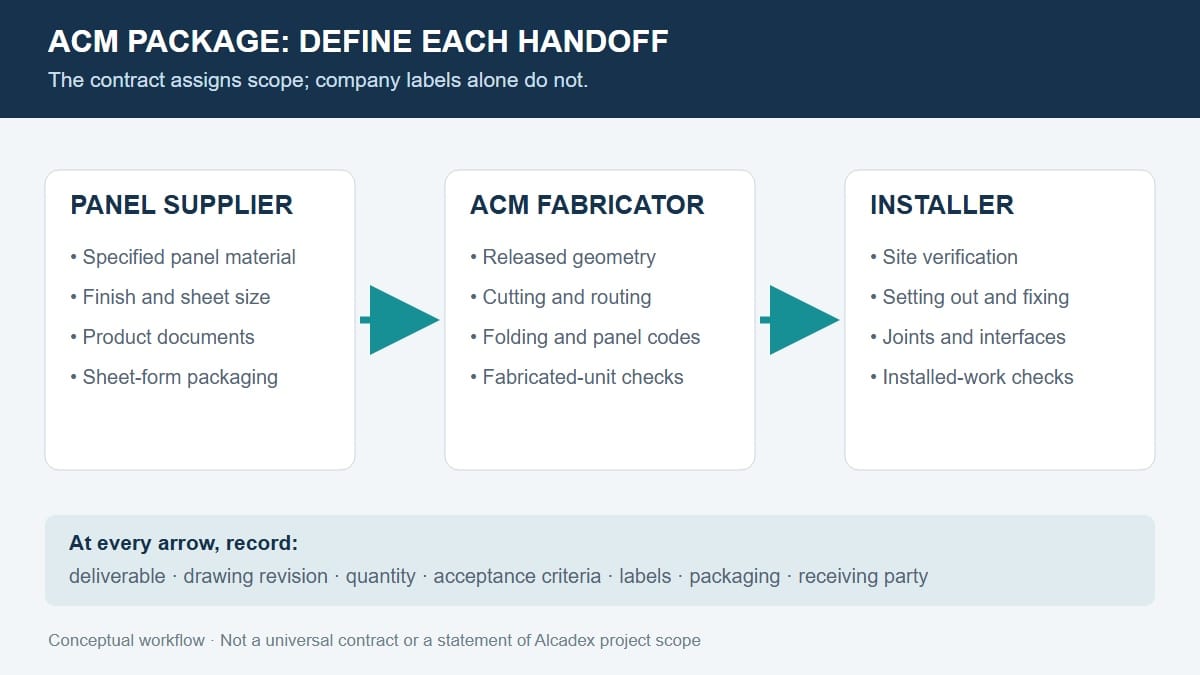
An ACM panel supplier provides the specified aluminum composite material, while an ACM fabricator converts that material into project-specific parts such as cut sheets, routed blanks, folded cassettes or labeled panel units. One company may perform both roles, but the purchase order must still state which material, engineering, drawing, fabrication, quality and delivery responsibilities are included.
The practical difference is not the company name. It is the point at which an order changes from standard panel supply to project-specific work. Buyers should define that point before comparing quotations; otherwise, two prices may cover very different deliverables and leave essential work unassigned.
ACM Fabricator vs Panel Supplier at a Glance
ACM means aluminum composite material. ACP, or aluminum composite panel, is also widely used in quotations and drawings. In this article, “panel supplier” refers to the party supplying the specified composite panel, and “fabricator” refers to the party converting it to project geometry. Contract wording and approved submittals remain controlling.
| Scope item | Panel supplier | ACM fabricator | Buyer check |
|---|---|---|---|
| Primary output | Specified full sheets or agreed material units | Project-specific cut, routed, folded or assembled parts | Name the physical deliverable |
| Material definition | Product construction, finish, dimensions and batch information | Verifies released material against fabrication documents | Keep the quoted and fabricated material identical |
| Geometry | Standard sheet dimensions unless cutting is included | Produces parts to released drawings and tolerances | Identify drawing revision and dimension basis |
| Documents | Product data, samples and applicable material records | Fabrication drawings, part codes and process or inspection records as specified | List every required document |
| Packaging | Protects the supplied sheet form | Protects fabricated shape, edges, labels and accessories | Match packing to transport and site sequence |
A supplier may offer optional cutting or fabrication, and a fabricator may purchase material on the buyer’s behalf. That does not make the terms interchangeable. List every included service and document rather than inferring capability from a marketing label such as “one-stop solution.”
Start by Defining the Deliverable
The clearest scope question is: what physical item should arrive at the next party? A distributor may need full sheets in protected pallets. A sign shop may need cut rectangles. A facade contractor may need folded cassettes with panel codes. Each request needs different drawings, tolerances, packaging and acceptance checks.
Use one of four descriptions in the RFQ: full sheet, cut-to-size blank, routed and grooved blank, or completed fabricated unit. Then add the required finish, dimensions, identification and packaging. Avoid the word “panel” by itself when both flat sheets and folded cassettes appear in the same project.
If the quotation covers full sheets only, fabrication waste, nesting, routing, trial pieces and completed-unit packaging are normally outside that material quantity unless explicitly included. If the quotation covers fabricated units, establish whether the quoted price includes gross material usage or only finished areas. This prevents a later disagreement about offcuts and replacement pieces.
Material Responsibility Belongs in the Quotation
The panel supply line should identify the product configuration being purchased. Record total panel thickness, aluminum skin thickness, core type, coating or finish, color reference, gloss or direction where relevant, sheet size and protective film. Available configurations depend on the selected product and order specification.
Also identify who orders material and who confirms quantity. When a fabricator purchases sheets, the buyer should still receive a traceable material description. When the buyer supplies free-issue sheets to a fabricator, the handover record should note quantities, visible condition and approved batch references.
Color and finish approval should occur before project-specific cutting begins. Mixing replacement sheets without reviewing batch, gloss or directional finish can create a visible mismatch even when the written color code appears the same. Link the purchase order to the approved sample and retain the sample reference in the fabrication package.
For projects requiring technical documents, use an ACP technical submittal register to distinguish the datasheet, finish sample, drawing and any applicable report. A supplier document describes its stated scope; it does not automatically approve a fabricated wall system.
Fabrication Responsibility Begins with Approved Geometry
Fabrication turns a material schedule into physical parts. Depending on the order, the work may include nesting, CNC routing, cutting, V-grooving, drilling, folding, reinforcing, attaching profiles or brackets, applying identification labels and preparing replacements. Each operation needs a drawing basis and measurable acceptance criteria.
A fabricator should not be expected to invent missing design decisions from an architectural elevation. Before release, confirm panel dimensions, joint locations, returns, corner conditions, penetrations, edge details, fixing interfaces and panel codes. Read the Alcadex guide to ACP shop drawings and panel coordination for the information normally needed to connect elevations with production.
The design party must also identify which dimensions are fixed and which may be adjusted. A fabricator can manufacture an approved geometry; responsibility for structural adequacy, building interfaces and local approval should not be transferred by vague notes such as “fabricator to verify all.” Assign design and engineering obligations expressly.
| Stage | Lead question | Typical required output | Approval gate |
|---|---|---|---|
| Material selection | Which panel configuration is specified? | Product description and approved finish sample | Material approval before ordering |
| Panelization | Who converts design intent into panel geometry? | Coordinated panel layout and codes | Shop drawing release |
| Fabrication | Who produces and checks project parts? | Fabricated units and inspection status | First-off or production acceptance when specified |
| Delivery | Who protects, labels and records each unit? | Packing list and traceable packages | Receiving inspection |
| Installation | Who verifies site interfaces and fixes panels? | Installed work to approved documents | Project inspection and handover |
What the Alcadex Fabrication Photo Shows
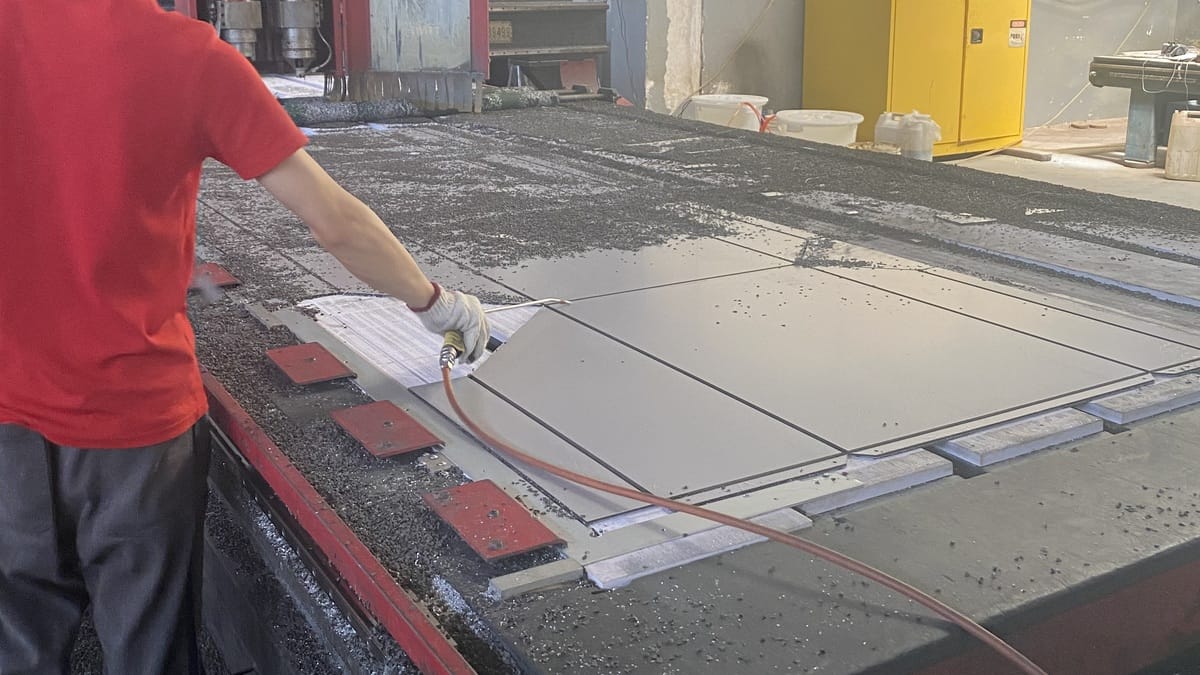
The factory photograph below shows a worker handling composite panel blanks on a CNC routing table. Routed outlines are visible on the protective surface. This is real fabrication context, but the image does not by itself prove a particular tolerance, project scope or inspection result.
A useful production release therefore pairs the imageable operation with controlled information: approved drawing revision, panel code, material batch, machine program or cut file, tolerance criteria and inspection record. The ACP CNC routing and tolerance guide explains why the material, toolpath, groove and fold requirements must be coordinated.
Photos can support progress communication or identify a process stage, but they are not a substitute for the purchase-order scope or inspection record. If a buyer requires first-off approval, state which dimensions and visual details must be checked, who accepts them, and whether production may continue before approval.
Who Owns Shop Drawings and Engineering?
“Shop drawings included” is incomplete unless the required drawing level and approval route are defined. A drafting service may translate an approved design into panel elevations and fabrication details. Engineering may involve calculations, support selection or system decisions. These are different services and should not be combined into one undefined line item.
State who provides the architectural background, survey, design criteria and current interfaces. State who prepares panel layouts, fabrication sheets and bills of material. If calculations or signed documents are required, identify the responsible qualified party and the jurisdiction. Never assume that purchasing fabricated panels includes project engineering.
Approval should also have a clear meaning. An architect may review appearance and design intent, while a contractor checks dimensions and coordination. A fabricator may review manufacturability. Record what each approval does and does not cover rather than relying on a generic “approved” stamp.
Installer Responsibility Is a Separate Handoff
The installer receives fabricated units and connects them to the building. Installation can include setting out, brackets or rails, panel positioning, fasteners, joints, sealants, membranes and interface coordination. These tasks are not automatically included in panel manufacture.
A complete handoff package may include a packing list, panel code map, orientation marks, approved drawings and handling notes. The installer should check delivery condition and compare labels with the setting-out plan before distributing units around the site. Damage or missing pieces should be recorded promptly with the relevant panel codes.
Site dimensions deserve special attention. Define whether fabrication uses design dimensions, an approved survey, or field measurements supplied by another party. Also state who bears the risk if a supporting opening or subframe differs from the issued dimensions. Do not wait until completed cassettes arrive to resolve the measurement basis.
Build a Responsibility Matrix Before Award
A responsibility matrix does not replace the contract, but it exposes gaps while corrections are still inexpensive. Use named organizations rather than generic role labels in the final version. For each line, assign one lead party and identify review or input parties separately.
| Task | Supplier input | Fabricator input | Buyer must assign |
|---|---|---|---|
| Panel specification | Confirms available quoted construction | Checks compatibility with fabrication scope | Final specified and approved material |
| Quantity and nesting | Confirms sheet sizes and supply quantities | Calculates gross usage from released geometry | Waste, spares and offcut ownership |
| Drawings | Provides product limitations when applicable | Prepares fabrication information if contracted | Design, survey, engineering and approval roles |
| Quality control | Checks supplied material within agreed scope | Checks fabricated geometry within agreed scope | Acceptance criteria and records |
| Packing and delivery | Protects material in supplied form | Protects completed parts if included | Incoterm, unloading, storage and site sequence |
| Installation | Normally excluded unless contracted | Normally excluded unless contracted | Installer, subframe, fixings, joints and site verification |
Where one company performs several roles, keep the lines separate. That makes the quotation easier to audit and helps the buyer see whether a subcontracted activity changes the technical or delivery risk. It also provides a clearer basis for replacement orders and warranty discussions.
Compare Quotations on the Same Scope
Start by normalizing the unit of comparison. One bidder may quote per full sheet, another per square meter of finished panel and another per fabricated unit. Record gross material, finished quantity, waste basis, programming, tooling, trial pieces, accessories and packaging before comparing the total.
Then compare exclusions. Common scope differences may include survey, shop drawings, calculations, optimization, special cutouts, reinforcement, fixing accessories, sealants, protective film replacement, first-off samples, inspection records, export packing and site installation. An exclusion is not necessarily a problem when it is visible and assigned to another party.
Confirm revision control and change pricing. State the drawing issue used for the quotation and define how quantity, geometry, finish or delivery changes will be handled. A lower initial price can become difficult to manage if every routine clarification is treated as a new undefined service.
Finally, compare lead-time assumptions without inventing a promise. Separate material availability, sample approval, drawing preparation, drawing review, fabrication, packing and transport. Request a project-specific schedule based on the selected scope and quantity.
Packaging Must Match the Next Handling Step
Full sheets and fabricated cassettes do not always need the same packing arrangement. Completed parts may have returns, brackets, labels or exposed edges that require separation and restraint. Define pallet or case type, orientation, maximum practical handling unit, label format and destination conditions in the quotation.
State who prepares the packing list and how panel codes map to crates or pallets. Sequenced packing can reduce site sorting, but only when installation zones and delivery priorities are available before packing. Review the ACP packaging and surface-protection checklist when assigning these requirements.
Incoterm and named destination do not describe fabrication quality. They allocate defined delivery responsibilities. Keep commercial delivery terms alongside, but separate from, the technical acceptance of material and fabricated units.
RFQ Checklist for a Complete ACM Package
- Deliverable: full sheets, cut blanks, routed blanks or fabricated units.
- Material: panel construction, skins, core, coating, finish, color, size and protective film.
- Quantity basis: gross sheets, finished area, units, spares, waste and offcut ownership.
- Documents: product data, samples, panel schedule, shop drawings, cut files and inspection records.
- Design responsibility: architectural intent, survey, panelization, engineering, interfaces and approvals.
- Fabrication: cutting, routing, grooving, drilling, folding, reinforcement, accessories and labeling.
- Tolerances: measurable criteria for blanks, folds, holes, returns and assembled geometry.
- Approval gates: sample, first-off unit, drawing release and production authorization.
- Packaging: pallet or case, separation, labels, sequence, packing list and replacement identification.
- Delivery and installation: Incoterm, destination, unloading, storage, setting out and site fixing.
- Changes and defects: revision procedure, reporting period, replacement basis and responsible contact.
Attach the same schedule and drawings to every bidder. Ask each company to return a marked scope matrix with inclusions, exclusions and deviations. This produces a better comparison than requesting a single “fabricated panel price.”
Frequently Asked Questions
Can the panel supplier also be the ACM fabricator?
Yes, a company may supply material and perform fabrication. The order should still describe both scopes, the release documents and the acceptance points. Combined capability does not remove the need for responsibility control.
Does a fabricated-panel quotation include installation?
Not unless installation is explicitly listed. Confirm transport, unloading, site distribution, subframes, fasteners, sealants and installation labor as separate scope items.
Who should prepare the panel schedule?
The contract should name the responsible party. It may be prepared by the facade designer, contractor, specialist detailer or fabricator, depending on the project. Define the required inputs and approval route.
Who is responsible for site dimensions?
Assign responsibility in writing. State whether fabrication uses issued design dimensions or verified survey information, who supplies the survey and how discrepancies are resolved before production.
Should I buy extra full sheets or spare fabricated units?
Decide this from the replacement strategy, finish matching risk, project geometry and storage plan. List the agreed spare quantity and whether it is supplied as sheets or coded units.
What should I send Alcadex for a fabrication quotation?
Send the panel specification, finish reference, quantities, dimensions or drawings, fabrication requirements, tolerances, labeling and packaging destination. Alcadex can then clarify the quoted product and included services without relying on assumptions.
Request a Scope-Based Alcadex Quotation
For full sheets, cut blanks or project-specific fabricated composite panels, contact Alcadex with the current panel schedule and drawings. Request material data, samples and a quotation that lists the included fabrication, labeling and packaging scope. A clearly assigned handoff gives the supplier, fabricator, installer and buyer the same definition of completion.