


18 Aug ACP Packaging: Pallets, Cases and Surface Protection
ACP packaging should keep sheets flat, surfaces separated, edges protected, and bundles stable through lifting, storage, and transport. A complete packing specification defines the protective film, interleaving or cover boards, edge and corner protection, strapping, pallet or case, labels, bundle limits, and handling method. “Export packing” alone is not specific enough for a reliable quotation.
The correct package depends on panel size, finish sensitivity, sheet or fabricated-part format, order quantity, route, transport mode, unloading equipment, storage conditions, and local packaging rules. Buyers should agree on these details before production release because changing the package after panels are complete can affect cost, dimensions, weight, and loading efficiency.
What Does an ACP Packaging System Need to Protect?
Aluminum composite panels combine large surface area with relatively thin skins and finished faces. The package therefore has to manage several risks at the same time: surface rubbing, edge impact, corner crushing, local strap pressure, bending from uneven support, moisture exposure, dirt, bundle movement, and misidentification.
No single layer performs every function. Protective film helps keep the coated face clean and reduces light surface marking during normal handling, but it is not an impact barrier. A cover board spreads contact and keeps tools or straps away from the face. Edge and corner protectors reduce concentrated pressure. A base pallet or case supports the stack and provides a controlled lifting interface. Labels connect the bundle to the order and packing list.
| Packaging Element | Primary Function | What the Buyer Should Specify |
|---|---|---|
| Surface protective film | Protects the finished face during suitable fabrication and handling | Film on one or both faces, removal timing, finish compatibility, and printed direction marks where needed |
| Top and bottom cover boards | Separate the panel stack from straps, tools, dust, and pallet contact | Coverage, board material, thickness where critical, and moisture exposure expectations |
| Edge and corner protection | Spreads local pressure and reduces impact at vulnerable edges | Protected sides, corner style, finish sensitivity, and fabricated-part geometry |
| Straps and load spreaders | Keep sheets and package components together | Strap material, positions, protectors, bundle count, and handling limitations |
| Pallet, skid, or case | Supports the load and creates lifting or stacking points | Forklift entry, lifting direction, route, destination requirements, and allowable package dimensions |
| Wrapping or moisture barrier | Reduces exposure to dust, splash, and changing transport conditions | Transport mode, storage duration, ventilation needs, and whether outdoor exposure is expected |
| Labels and packing list | Links each package to the order, product, quantity, and destination | Required fields, language, package numbering, barcodes, and installation-zone references |
Start with the Exact Panel and Transport Scope
Packaging cannot be selected from the product name alone. Record the panel width, length, total thickness, finish, quantity, sheet format, and whether the shipment contains full sheets, cut blanks, or fabricated cassettes. A long panel needs different support from a small blank, while a mirror or high-gloss surface may require more careful separation than a less reflective finish.
Then map the journey. Will the package move by forklift, crane, container, truck, or several modes? How many times will it be transferred? Will the buyer unload from the side, rear, or top? Is there covered storage at destination? Are there package-size, fumigation, or material-entry rules that apply to the selected destination? These answers determine whether a simple supported bundle is sufficient or whether a more enclosed package should be considered.
The quotation should state what is included. Ask the supplier to identify the base support, cover materials, edge protection, strapping, wrapping, labeling, and maximum or planned bundle quantity. If special wooden packaging, moisture protection, custom labels, or separated lots are required, add them to the RFQ rather than assuming they are standard.
Surface Protection Starts Before the Outer Package
The visible face should be protected from sliding contact, abrasive particles, tools, dirty gloves, and exposed strap hardware. Inspect the factory-applied protective film before packing. It should remain attached and appropriate for the selected finish and planned processing. If a panel has two visible faces, confirm whether both require protection.
Protective film is temporary. Storage temperature, sunlight, moisture, time, and contamination can affect removal. The buyer should follow the panel supplier’s removal guidance and avoid leaving film on the installed surface longer than the agreed period. The separate guide to ACP protective film storage and removal explains why film condition must be checked before fabrication and installation.
Cover boards add a sacrificial layer above and below the sheet stack. They should cover the critical face area and remain free from hard debris. For especially sensitive finishes or fabricated pieces, ask whether interleaving, sleeves, separators, or individual wrapping are required. These measures should be matched to the actual product; excessive layers can add cost and handling time without solving the main risk.
Pallets, Skids, and Cases: Which Format Fits?
A pallet or skid provides a base that can be handled and supported. A case adds side or top enclosure. Neither is automatically better for every shipment. The selection depends on panel geometry, route, transfer frequency, weather exposure, stackability, destination handling, and cost.
An open supported bundle gives the receiver easier visibility and may use less packing material. It also exposes the sides and top to more handling risk. A more enclosed case can provide additional separation from surrounding cargo and accidental contact, but it increases package size and may make inspection less convenient. Poorly designed enclosure can still leave the load unsupported or trap moisture.
| Decision Factor | Supported Pallet or Skid | Enclosed Case |
|---|---|---|
| Access for inspection | Usually easier to view the bundle and labels | May require opening a panel or lid for full inspection |
| Side and top protection | Depends heavily on cover boards, wrapping, and handling discipline | Can provide more separation from adjacent cargo when properly designed |
| Package size and tare weight | Generally uses less enclosure material | Adds material, dimensions, and weight that must be included in logistics planning |
| Irregular fabricated parts | May need custom supports and separators | Can help contain custom supports, but internal restraint still matters |
| Best use decision | Suitable when the route and handling plan control exposure | Consider where additional enclosure is justified by route or handling risk |
The base must support the bundle without creating a long unsupported span. Fork entry points should be compatible with available equipment, and the center of gravity should remain predictable. If packages may be stacked, the load path should pass through structural supports rather than through the panel faces.
Strapping Without Concentrated Panel Damage
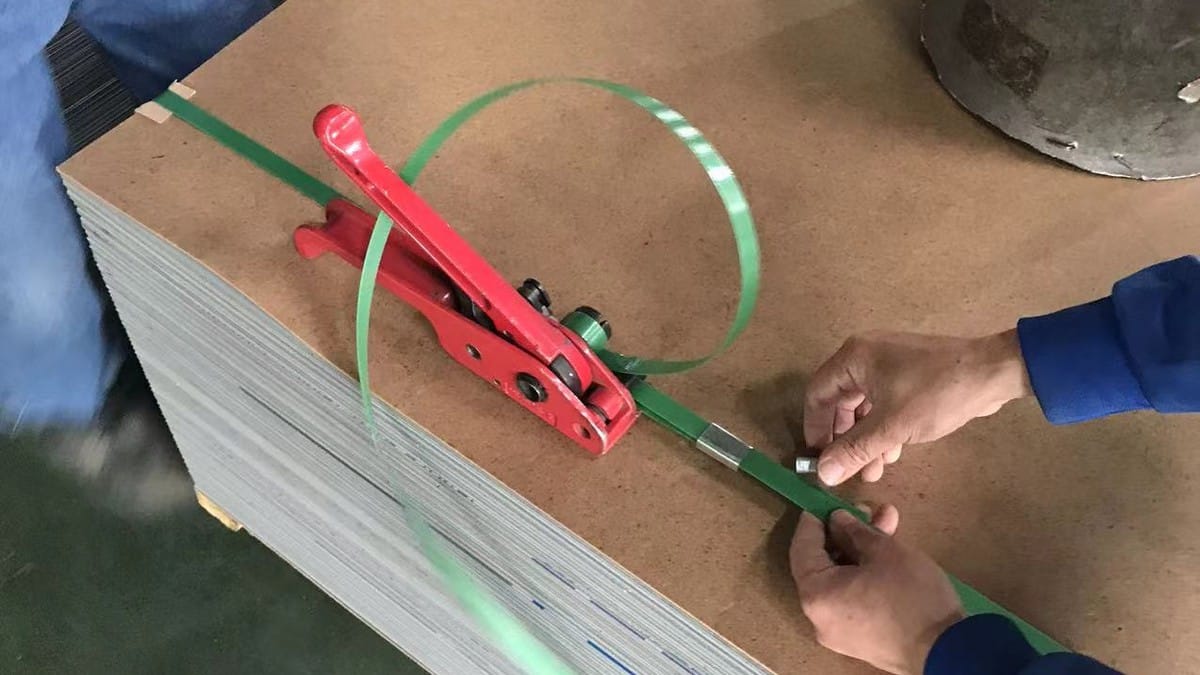
Straps keep the bundle together during normal movement. They should be positioned over protective boards or load spreaders so force is not applied directly to the finished panel face or a vulnerable edge. Strap hardware, seals, and cut ends should be isolated from the coating.
The goal is stability, not maximum tension. Excessive local pressure can mark cover boards, crush edges, or distort a poorly supported stack. Too little restraint allows sheets or package components to shift. The packer should inspect the bundle geometry, protection at contact points, strap position, and closure before release.
Strap quantity and spacing should be based on package dimensions, weight, stiffness, transport method, and lifting plan. Do not copy a fixed number from another project with different sheets. If the package will be lifted by slings, clarify whether separate lifting points or a lifting frame are required; ordinary packing straps should not be treated as lifting slings unless the package design explicitly provides for that use.
Moisture, Condensation, and Storage Planning
Wrapping can reduce exposure to dust and splash, but it does not make every package suitable for outdoor storage. Temperature changes during transport may create condensation, especially when a sealed or cold bundle enters a warmer humid environment. Wet cover materials, trapped water, and long storage periods can affect labels, protective film, surface cleanliness, and package stability.
The buyer should provide a dry, level, covered receiving area and follow the supplier’s storage instructions. Keep the package supported as intended and away from standing water. Before removing wrapping, check whether the bundle needs time to acclimate. If moisture is visible, document it and inspect the sheets before moving them into production or installation.
Do not promise a universal moisture-control method without knowing the route and package design. A sealed barrier, ventilation, desiccant, or different wrap may be considered for a particular shipment, but each has limitations. Ask the supplier to explain the proposed method and its assumptions.
Labels and Packing Lists Make the Package Traceable
A protected bundle is still difficult to manage if no one can identify it. The outer label should remain visible during normal receiving and contain the fields agreed for the order. Typical project fields include purchase order, product or finish code, dimensions, sheet quantity, package number, gross or net weight where provided, destination, and handling notes.
For multiple colors, sizes, floors, elevations, or fabricated panel codes, create a package sequence that supports unloading and installation. Avoid placing the first-needed parts at the bottom of an inaccessible stack. The packing list should reconcile the quantity in every package with the total order and identify any mixed bundle.
Photographs taken before dispatch can document the package appearance, labels, and visible restraint. They do not replace receiving inspection, but they create a useful reference when packaging is damaged or a package number cannot be found.
The previously published guide to ACP technical submittals explains how product, drawing, sample, and label references can be coordinated before production.
Packaging Full Sheets and Fabricated Parts
Full sheets can usually be stacked with aligned edges on a continuous or suitably spaced support. Fabricated cassettes, folded returns, cutouts, stiffeners, and projecting parts create different contact points. They may need shaped supports, separators, nesting rules, orientation marks, and limits on the number of parts per package.
Do not let a finished return carry the weight of parts above it unless the package was designed for that load. Separate incompatible shapes and keep loose hardware away from coated faces. If fasteners, brackets, sealants, or accessories ship with panels, place them in identified containers rather than loose inside the package.
Directional finishes require clear orientation. Labels and packing diagrams should preserve the relationship between panel code, visible face, grain direction, and installation zone. This reduces unnecessary unpacking and rotation on site.
Pre-Shipment Packaging Checklist
Use a documented check before the goods move to the loading area. The check should compare the actual packages with the approved quotation, packing instruction, and order quantity.
| Check | Evidence | Hold the Package If |
|---|---|---|
| Product and quantity | Panel code, dimensions, finish, quantity, and order reference match | Any mixed or unidentified item remains unresolved |
| Surface and edges | Protective film, cover boards, corners, and visible edges are intact | Debris, exposed hardware, or damaged protection can contact the finish |
| Support and restraint | Base is level; straps and protectors are correctly positioned | The bundle can shift or the panel carries a concentrated load |
| Outer protection | Specified wrapping or enclosure is complete and undamaged | Openings, tears, or wet materials compromise the agreed protection |
| Identification | Labels are readable and reconcile with the packing list | Package number, product, or destination is unclear |
| Handling and loading | Fork entry, lift direction, weight information, and loading plan are aligned | Available equipment cannot safely handle the package geometry |
What Buyers Should Put in an ACP Packaging RFQ
- Exact panel construction, finish, width, length, quantity, and sheet or fabricated-part format.
- Required protective film and whether one or both faces are visible.
- Preferred pallet, skid, case, wrapping, cover-board, edge-protection, and separator requirements.
- Maximum acceptable package size or weight based on unloading equipment.
- Forklift entry direction, crane-lifting needs, and any site handling restrictions.
- Transport mode, transfer points, destination, storage conditions, and expected route exposure.
- Package numbering, label language, barcode, floor, elevation, or installation-zone references.
- Destination rules for wood packaging or other controlled materials.
- Required packing-list fields and pre-dispatch photographs.
- Responsibility for loading, cargo restraint, unloading, storage, and damage reporting.
Receiving the Package Without Losing Evidence
Inspect the package before unloading when practical. Record the container or vehicle condition, package position, visible movement, wet areas, broken straps, punctures, crushed corners, and unreadable labels. Photograph concerns before removing restraint or discarding packing materials.
After safe unloading, reconcile package numbers and quantities with the packing list. Open suspect packages under controlled conditions and inspect enough sheets to understand the extent of any damage. Separate transport damage from pre-existing product concerns, and notify the responsible parties within the agreed reporting period.
Use the complete ACP receiving inspection checklist to document labels, package condition, quantity, dimensions, surfaces, and follow-up actions.
Specify Packaging as Part of the Product Order
Effective ACP packaging is a coordinated system, not an accessory added at dispatch. It protects the face, distributes pressure, supports the bundle, enables controlled lifting, identifies the contents, and reflects the real transport route. The buyer’s best protection is a written package specification tied to the same panel schedule, quotation, and delivery plan.
Review the available Alcadex aluminum composite panel options, then send the panel specification, finish, dimensions, quantity, destination, transport mode, and unloading limits through the Alcadex contact page. Alcadex can include the agreed packing configuration and labeling requirements in a project-specific quotation.