

26 Aug ACP Acoustic Performance: What the Panel Can and Cannot Do
ACP acoustic performance depends on the panel construction and the assembly in which it is installed. An aluminum composite panel can be one component of a wall, ceiling, or enclosure, but the words ACP, mineral core, or perforated do not establish a sound absorption rating or a sound insulation rating. For a project with an acoustic target, evaluate evidence for the specified build-up, not just the decorative sheet.
For procurement teams, the first decision is whether the project needs less reflected sound inside a room, less sound passing between spaces, or control of a particular noise source. These are different requirements. This guide explains how to turn an acoustic claim into a clear specification and a comparable supplier quotation without assuming that a panel sample proves building performance.
ACP Acoustic Performance Starts with the Right Question
A request for “soundproof ACP” is too broad to quote responsibly. Ask where the noise originates, where the listener is located, and what acceptance criterion the project designer has specified. An open office with distracting reverberation and a meeting room with poor speech privacy may need different measures, even if both use the same wall finish.
| Buyer concern | Question to specify | Evidence to request |
|---|---|---|
| Reflections within a room | How much absorption does the proposed treatment provide? | Absorption data for the actual facing, backing, cavity and mounting |
| Speech between rooms | What sound insulation does the separating assembly provide? | Complete partition test or accepted project assessment, including interfaces |
| Outdoor noise indoors | Does the facade meet the project’s noise-source requirement? | Facade assessment covering opaque walls, glazing, doors and ventilation |
| Rattle, rain or equipment noise | Which source and installed condition must be evaluated? | An agreed source-specific evaluation, not an unrelated panel rating |
Write the requirement in the project specification before comparing products. If the brief contains only “good acoustic performance,” ask the design team to define the metric and the object being assessed. A supplier cannot demonstrate a clear pass or fail against an undefined description.
Sound Absorption Is Not Sound Insulation
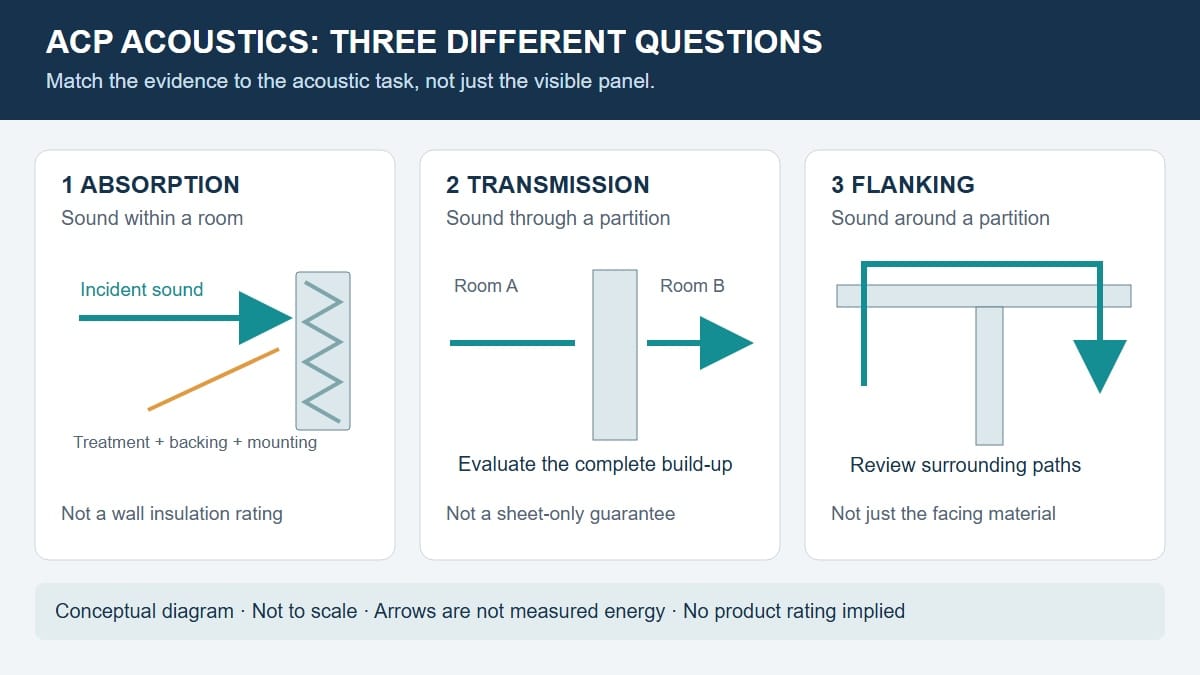
Absorption concerns sound within a space
Absorption describes the sound energy taken up by a material or treatment rather than returned to the room. The ASTM C423 reverberation-room method measures absorption using sound decay. Its results relate to the tested specimen and conditions; they are not a promise of the same outcome in every room.
If a quotation includes an absorption coefficient or an NRC value, request the associated report and the mounting description. As described in Intertek’s summary of absorption testing, NRC, or noise reduction coefficient, is an absorption rating, not a decibel reduction through a wall. Do not accept a comparison that places an absorption rating in one column and a wall insulation rating in another as though they measured the same property.
Sound insulation concerns transmission between spaces
For airborne transmission, a laboratory evaluates a separating element or assembly. Intertek’s explanation of ASTM E90 testing identifies this as measurement of airborne sound transmission loss and explains that the data can support STC or OITC ratings through their respective classification methods.
STC means sound transmission class. ASTM E413’s sound insulation classification distinguishes laboratory and field ratings and cautions that its familiar single-number approach is not suitable for every noise spectrum. Machinery, music and transportation noise can require frequency-specific assessment. A headline rating should therefore follow the project criterion, not replace it.
Neither test name is a general product approval. A report must identify what was tested. For example, evidence for a multi-layer wall faced with ACP does not make the same rating a property of an individual ACP sheet sold separately.
What a Solid or Perforated ACP Face Can Establish
A smooth, unperforated ACP face should not be specified as a room absorber simply because it contains a composite core. Equally, a perforated face is not enough information to assign an absorption rating. Ask for data on the proposed treatment, including anything behind the visible panel.
Alcadex’s guide to perforated ACP and its design limits distinguishes the decorative facing from the acoustic assembly. For a perforated proposal, record the pattern, open area, backing and cavity arrangement rather than accepting a photo of the face as evidence. This article addresses the evidence decision; the perforated-panel guide covers pattern and fabrication considerations.
For a solid-panel proposal, ask whether ACP is only a finish over a separately designed wall or whether it is a specified part of the tested separating assembly. Those two supply arrangements need different documentation. A decorative finish approval does not authorize changing the underlying acoustic wall specification.
| Proposed configuration | Procurement position | Do not assume |
|---|---|---|
| Solid ACP finish | Approve panel identity, finish and fixing arrangement separately from acoustic acceptance | That core type or appearance proves absorption or wall isolation |
| Perforated ACP facing | Match the facing and complete backing arrangement to relevant evidence | That every perforation pattern has the same acoustic result |
| ACP-faced partition | Review the full wall specification and junctions | That a sheet-only report covers the installed partition |
| ACP rainscreen facade | Coordinate the exterior panel package with the complete facade assessment | That the outer cladding determines indoor noise by itself |
Why the Complete Wall Matters More Than the Label
The National Research Council Canada’s explanation of sound transmission loss describes the influence of layer mass, stiffness, cavities and mechanical connections. It also explains flanking: sound reaching the receiving space through surrounding construction instead of only through the separating wall. These are reasons to review the build-up as a system, not a basis for calculating a universal ACP rating.
In procurement terms, the wall drawing and the acoustic evidence need to describe the same scope. Ask the responsible designer to review doors, glazing, service penetrations, perimeter details and ceiling junctions alongside the opaque wall. A carefully selected facing cannot validate a different door or an unassessed opening.
For an interior scheme, coordinate with the ACP partition design and specification guide. For an exterior scheme, keep acoustic questions separate from drainage and ventilation decisions. Do not close required cavity openings or alter a facade detail simply to pursue an acoustic improvement without the responsible designers’ approval.
Thickness alone is not an acceptance rule
Do not rank two quotations solely by total ACP thickness. Record aluminum skin thickness, core identification, panel dimensions and the proposed support arrangement, then compare relevant evidence. “Thicker” is not a substitute for a documented acoustic result for the construction being purchased.
A knock test is not an acoustic test report
Tapping samples may help a buyer notice that two pieces sound different under that informal condition. It does not establish the room’s absorption, the wall’s STC, or an outdoor-to-indoor result. Keep informal observations in the sample discussion rather than presenting them as project acceptance evidence.
Separate Alcadex Panel Approval from Acoustic Approval
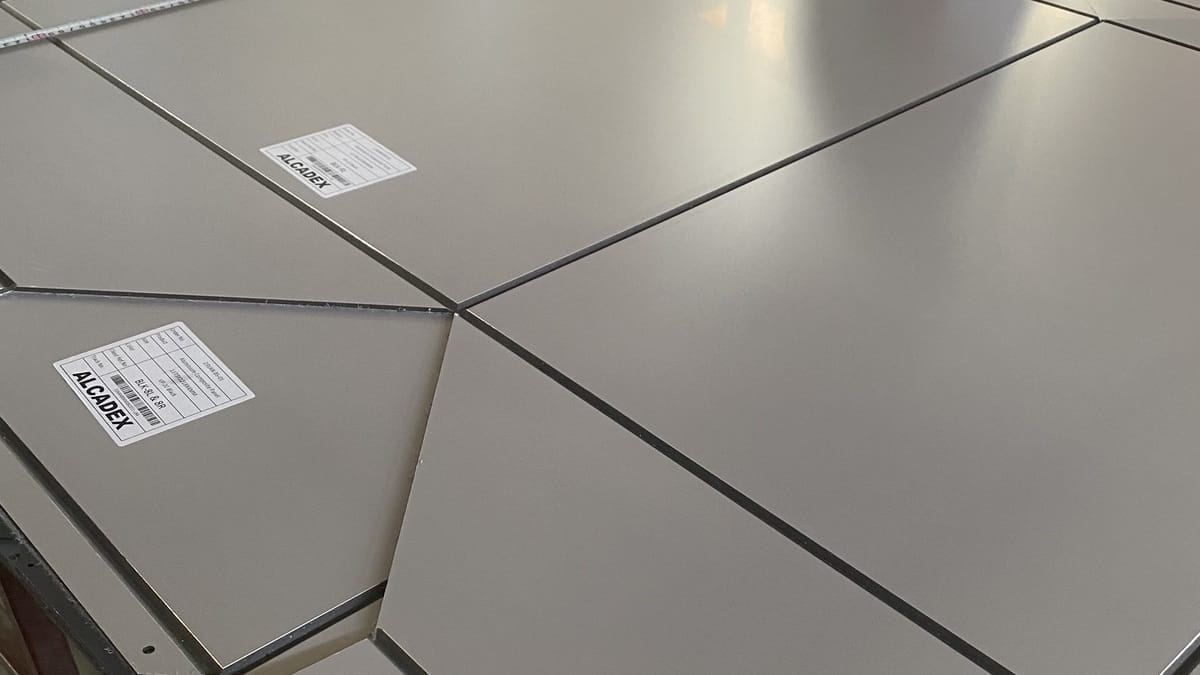
The Alcadex fabrication photograph below shows solid composite panels, identification labels and a measuring tape on a worktable. It is useful context for matching a physical panel to its fabrication documentation. It is not an acoustic test setup, and it does not support a numerical sound claim.
Use the same separation in the approval register. Panel approval can cover the specified material, finish, dimensions, fabricated geometry and sample reference. Acoustic approval should identify the relevant report or project assessment, its scope, and the party accepting it. One approval does not automatically close the other.
When requesting Alcadex material for an acoustically specified project, provide the wall or ceiling build-up and explain the panel’s intended role. Confirm the final panel construction in the quotation. If an acoustic value is required, ask which evidence applies to that exact configuration; do not apply a generic internet value to the order.
Keep the panel data, approved drawings and performance documents together using the ACP technical submittal checklist. A finish sample, a product datasheet and an assembly test report answer different questions, even when they appear in the same submission.
Read the Report Scope Before Comparing the Number
A one-page sales summary can help identify a candidate product, but it is not enough to resolve whether the tested construction matches your project. Request the complete relevant report, including specimen descriptions, drawings and any limitations. Have the project acoustician or responsible designer evaluate differences rather than asking the purchasing team to infer equivalence.
| Report item | Compare with the order | Escalate when |
|---|---|---|
| Test identity | Laboratory, report reference, date, method and edition | Only a logo, certificate headline or cropped result is supplied |
| Specimen identity | Named product, skins, core, thickness and dimensions | The quoted product differs from the tested product |
| Assembly and mounting | Layers, backing, cavity, supports, fasteners, joints and perimeter conditions | A material or construction detail has been omitted or substituted |
| Result and metric | Absorption or transmission result, frequency data and specified rating | The headline number answers a different acoustic question |
| Project application | Design acceptance, permitted variations and any field verification requirement | Laboratory evidence is presented as an unconditional building guarantee |
Ask suppliers to mark deviations explicitly. A clear statement that a proposed backing differs from the tested backing is more useful than a repeated headline rating. The design team can then decide whether existing evidence is sufficient, an assessment is needed, or the proposal should be revised.
Also confirm the commercial scope of any additional test or assessment before placing the order. Identify who supplies specimens, who pays the laboratory, which construction will be evaluated, and what happens if the required result is not achieved. Do not leave these responsibilities hidden in a general promise to provide “acoustic certification.”
Put the Acoustic Requirement into the RFQ
An effective request for quotation connects the material package to the project requirement while keeping responsibilities clear. Include the following information with the panel schedule:
- Application and location: interior finish, partition facing, ceiling treatment or exterior cladding, with the relevant room or facade reference.
- Noise concern: room reflections, inter-room speech, traffic, equipment or another identified source.
- Acceptance criterion: the designer’s required metric, test or assessment basis, and whether laboratory or installed performance is being requested.
- Panel identity: total thickness, aluminum skins, core specification, finish, dimensions and any perforation drawing.
- Assembly information: the current drawing revision, backing layers, cavity, support concept, joints and relevant interfaces.
- Evidence and responsibilities: documents required with the quotation, the design reviewer, proposed deviations and any additional verification scope.
Keep the wording specific. Instead of “provide soundproof panels,” ask the supplier to identify the quoted panel and submit evidence relevant to the attached assembly and acceptance criterion. State that proposed substitutions require review before manufacture. This gives all bidders the same basis for a meaningful response.
For a hypothetical meeting-room project, the team might approve a solid ACP finish for appearance while the acoustic designer separately approves the complete partition. If the contractor proposes changing a backing board or adding a service opening, the acoustic review must address that change. This is a coordination example, not a claimed Alcadex project or a tested wall detail.
Frequently Asked Questions
Is ACP soundproof?
ACP is not a universal soundproofing specification. State the acoustic requirement and evaluate the relevant panel or assembly evidence. Avoid a blanket claim that one sheet type blocks all noise in any installation.
Does a mineral-core ACP automatically absorb sound?
No absorption rating should be inferred from the core description alone. Request results for the proposed construction and mounting. A core label does not establish that the room-facing treatment has been tested for absorption.
Can perforated ACP be used in an acoustic treatment?
It can be considered as a facing within a designed treatment, subject to the specified configuration and evidence. Confirm the backing and mounting rather than assigning a rating from the visible pattern.
Can I add the ACP rating to the backing wall’s rating?
Do not add separate product ratings to create an assembly rating. Submit the proposed combined build-up for the responsible designer’s assessment and use evidence that is applicable to that construction.
Does an acoustic report prove fire performance?
No. Acoustic evidence does not establish a fire classification or project approval. Review those requirements through their own applicable documents and keep the approved material and assembly descriptions coordinated.
What should I send Alcadex first?
Send the panel schedule, intended application, drawing revision and the acoustic requirement set by the project designer. Identify whether you need sheet material, fabricated panels or documentation for a defined panel configuration.
Discuss the Panel Specification with Alcadex
For an ACP project with acoustic requirements, contact Alcadex with your panel specification and project drawings. Request samples, product data and a quotation tied to the intended application. Keep the acoustic target and evidence scope visible from the first inquiry so that panel selection, fabrication approval and system-level review remain aligned.