

02 Sep ACP Pencil Hardness Testing Explained
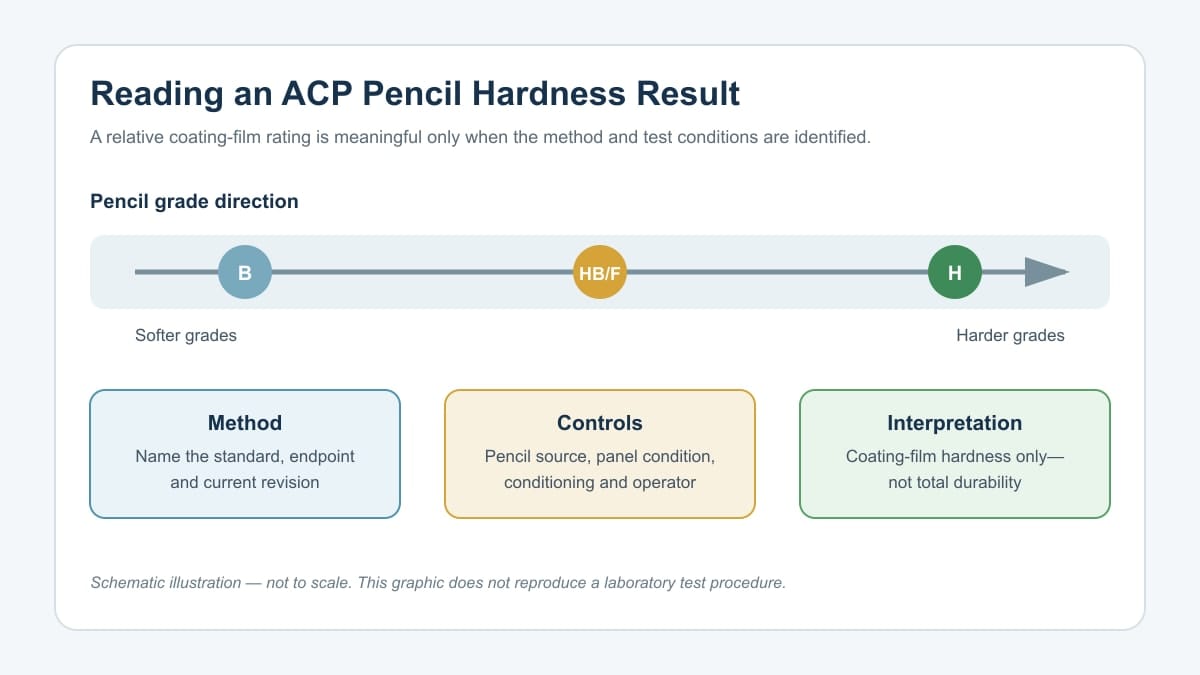
ACP pencil hardness testing gives a relative rating for the hardness of the panel’s organic coating film. A pencil or drawing lead of known grade is pushed across a smooth coated surface under a defined method, and the observed coating response is reported as a pencil grade. The result can support production control and finish evaluation, but it is not a complete measure of scratch resistance, abrasion resistance, adhesion, impact performance or outdoor durability.
For buyers, the most important question is not simply “How many H?” It is whether the report names the test method, endpoint, coating system, panel condition and test controls. A rating without those details is difficult to compare and should not be treated as a universal quality grade for aluminum composite panels.
What Is ACP Pencil Hardness?
ACP pencil hardness is the reported resistance of the coated face to a specified pencil-test endpoint. The test concerns the organic coating film on the aluminum skin, not the hardness of the aluminum, core or complete panel. It may be applied to a single coating or the upper layer of a multi-coat system, depending on the referenced method and specimen.
Pencil grades progress from softer B grades, through HB and F, to harder H grades. A higher H designation indicates that a harder lead met the stated endpoint under the test conditions. The sequence is ordinal: it ranks performance within that test. It is not a linear engineering scale, so 4H should not be described as “twice as hard” as 2H.
The result also needs an endpoint name. A method may distinguish a visible surface mark from a more severe failure such as cutting or gouging the film. If one report uses one endpoint and another uses a different endpoint, their grades cannot be compared fairly just because both use pencils.
| Term | What it describes | What it does not prove |
|---|---|---|
| Pencil hardness | Relative coating-film response to graded leads under a named method | Overall service life or resistance to every form of damage |
| Scratch resistance | Response to a scratching action under specified geometry and load | Abrasion, adhesion or impact performance |
| Abrasion resistance | Resistance to wear caused by repeated rubbing or abrasive action | A direct equivalent to an H-grade result |
| Adhesion | How the coating remains attached to its substrate under a defined test | The surface film’s pencil hardness |
| Impact resistance | Response to sudden mechanical loading under a defined test | Resistance to a pencil lead moving across the surface |
ASTM D3363 and ISO 15184
Two commonly referenced documents are ASTM D3363, Standard Test Method for Film Hardness by Pencil Test, and ISO 15184, Paints and varnishes — Determination of film hardness by pencil test. Both address pencil testing of organic coating films, but ASTM states that its method is similar in content to ISO 15184 and is not technically equivalent.
That distinction matters in procurement. A quotation or data sheet should not replace one standard with the other silently. The parties should name the required document and edition, especially when a project specification, consultant or coating supplier already defines the test basis.
ISO describes the pencil test as a rapid method that is more useful for relative ratings among coated panels with significant hardness differences than for comparing unrelated coatings. It also limits the method to smooth surfaces. ASTM highlights its usefulness for development and production control within one laboratory and warns that pencils, batches and laboratories can affect reproducibility.
| Comparison item | ASTM D3363 | ISO 15184 | Buyer action |
|---|---|---|---|
| Primary scope | Film hardness of an organic coating using known pencil leads | Film hardness by pushing pencils of known hardness over the film | Name the method instead of requesting “a pencil test” only |
| Relationship | Similar to, but not technically equivalent to, ISO 15184 | Separate ISO method | Do not merge results into one unnamed requirement |
| Typical value | Development and production-control comparison | Relative rating of smooth coated panels | Use results inside a controlled, documented comparison |
| Important control | Pencil manufacturer and batch can influence results | Surface and test conditions must follow the selected method | Request the test conditions and report details |
What Can Change the Reported Grade?
Pencil testing appears simple, but its reproducibility depends on control. Pencils with the same grade marking can behave differently when they come from different manufacturers or production batches. Lead preparation, panel support, coating cure, temperature, conditioning, operator technique and failure interpretation can also affect the result.
The specimen must represent the product being evaluated. A laboratory coupon with a different substrate, pretreatment, primer, topcoat, cure schedule or film build is not automatically evidence for the quoted ACP. If a report is submitted for approval, its construction should be matched to the proposed panel and coating system.
| Control variable | Why it matters | Evidence to retain |
|---|---|---|
| Standard and edition | Different methods or revisions may not be directly interchangeable | Full method designation and report date |
| Reported endpoint | Scratch and more severe film failure are different observations | Endpoint name, grade and acceptance criterion |
| Pencil source | Manufacturer and batch can change lead behavior | Pencil manufacturer and lot or batch |
| Panel construction | Substrate, pretreatment and coating layers influence the specimen | Product code, coating system, color and batch |
| Cure and conditioning | Film development and temperature can affect the observed response | Specimen age, conditioning and test environment |
| Surface condition | Texture, contamination, damage or protective film can distort the assessment | Clean test area and confirmation that the finished coating was exposed |
| Operator and laboratory | Preparation and visual interpretation can introduce variation | Laboratory, operator or internal procedure reference |
How Buyers Should Interpret an ACP Test Report
Start with product identity. Confirm that the report refers to the coating system and construction proposed in the quotation, not simply to a generic “PVDF,” “PE” or decorative ACP family. Coating chemistry alone does not establish a pencil grade, and one result should not be applied to every color, gloss, film build or production route without supporting scope.
Next, read the test basis and result together. Look for the named standard, edition, endpoint and grade. Check whether the document records the pencil source, specimen condition and laboratory. If only a marketing table is provided, ask whether a traceable report or supplier-controlled production record is available for the relevant finish.
Then compare like with like. A grade from ASTM D3363 should not be presented as if it were produced under ISO 15184. A test on a smooth solid-color panel may not describe a textured or effect finish. Results from separate laboratories should be compared cautiously unless the pencils, specimens and procedure were controlled.
Finally, connect the report to the project requirement. If the specification names no method or acceptance grade, resolve that gap before ordering. If it names an unrealistic combination of tests or a result copied from another material, ask the design authority to clarify the intended performance rather than silently substituting a convenient value.
Pencil Hardness Is Not the Same as Field Scratch Resistance
A pencil test uses a defined lead and observation on a prepared surface. Real ACP damage may come from metal tools, grit trapped under protective film, dragged packaging, fabrication swarf, cleaning pads or contact with adjacent components. These actions have different shapes, loads and repetition from a laboratory pencil.
A higher pencil grade therefore does not make a panel “scratch-proof.” Handling and fabrication controls still matter. The guide to ACP scratches, dents and repair limits explains why deep coating damage and metallic-finish distortion may require replacement rather than a cosmetic field repair.
Protective film also remains a temporary handling aid, not a hardness upgrade. It should be stored, processed and removed according to the documented conditions. See the Alcadex guide to ACP protective film storage, removal and residue for the separate risks involved.
Does Pencil Hardness Prove Coating Cure?
Pencil hardness can be used as one production-control indicator for coating cure, especially when a laboratory has correlated the result with its own coating system and process. It does not independently prove that every coating property, pretreatment step or cure parameter is correct.
A film may reach an expected pencil rating while another property still requires evaluation. Conversely, a result outside an internal target may reflect conditioning, pencil variation or operator interpretation rather than a single confirmed production cause. Investigation should follow the coating supplier’s and manufacturer’s control plan instead of relying on one number.
RFQ and Submittal Checklist
When pencil hardness is relevant to the project, include it in the written finish schedule or quality requirement. Do not leave it as an informal question after production. A clear request lets the supplier confirm what can be documented for the selected product.
- Name the required test standard and edition.
- State the required endpoint and acceptance grade, if the project has established one.
- Identify the exact coating system, finish code, color, gloss and relevant film build.
- Ask whether the evidence is a third-party report, coating-supplier data or factory production-control record.
- Request specimen identity, panel or batch reference, test date and laboratory.
- Confirm pencil manufacturer and batch when cross-laboratory comparison is important.
- Keep pencil hardness separate from adhesion, abrasion, impact, weathering and corrosion requirements.
- Define the action if a production-control result differs from the approved requirement.
These items can be incorporated into an ACP technical submittal so the sample, product data and test evidence refer to the same proposed construction.
Common Specification Mistakes
Requesting “high pencil hardness” without a method
“High” is not an auditable requirement. Name the method, endpoint and acceptance value, or ask the supplier to state its available test basis.
Assuming every H-grade is a universal performance class
Pencil grades are relative results from a specific procedure. They are not a certification class and should not be converted into service-life, warranty or global compliance claims.
Using hardness as a substitute for adhesion
A hard topcoat can still require separate evidence for adhesion to the layer below. Keep the properties and their test methods separate in the specification.
Comparing different finishes without checking scope
Texture, coating construction, cure and specimen preparation can affect the result. Confirm that both reports represent comparable surfaces and conditions.
Ignoring receiving and fabrication controls
A compliant laboratory result does not prevent scratches caused after production. The ACP receiving inspection checklist helps buyers preserve package, batch and surface evidence before fabrication begins.
Frequently Asked Questions
Is 3H better than 2H for ACP?
3H is a harder pencil grade than 2H within the same controlled test, but “better” depends on the specified coating, method, endpoint and intended use. The grades should not be compared across unrelated reports without checking those conditions.
Can pencil hardness be tested through protective film?
No meaningful coating-film rating should be inferred from testing the temporary protective layer. The test specimen must expose the finished coating and follow the selected standard’s surface requirements.
Does a high pencil grade mean the ACP cannot be scratched?
No. Pencil hardness does not make a surface scratch-proof. Sharp tools, grit, metal swarf and improper cleaning can still damage a coating.
Are ASTM D3363 and ISO 15184 results identical?
No. ASTM describes its method as similar in content to ISO 15184 but not technically equivalent. The report and purchase requirement should identify which method was used.
Should every ACP order require pencil-hardness testing?
Not necessarily. The need depends on the coating specification, buyer quality plan and project requirements. When it is requested, the acceptance basis should be defined before production.
Request Coating Evidence for the Quoted Panel
Pencil hardness is most useful as a controlled, traceable coating-film check—not as a stand-alone marketing number. Specify the method, endpoint, product construction and report details, then review the result alongside the other finish properties that matter to the project.
If you are sourcing ACP for distribution, signage or construction, send Alcadex the intended application, panel construction, coating and finish code through our contact page. Request the available product data, samples and test documentation for the exact specification included in your quotation.