

03 Sep ACP Salt-Spray Testing: What Results Mean
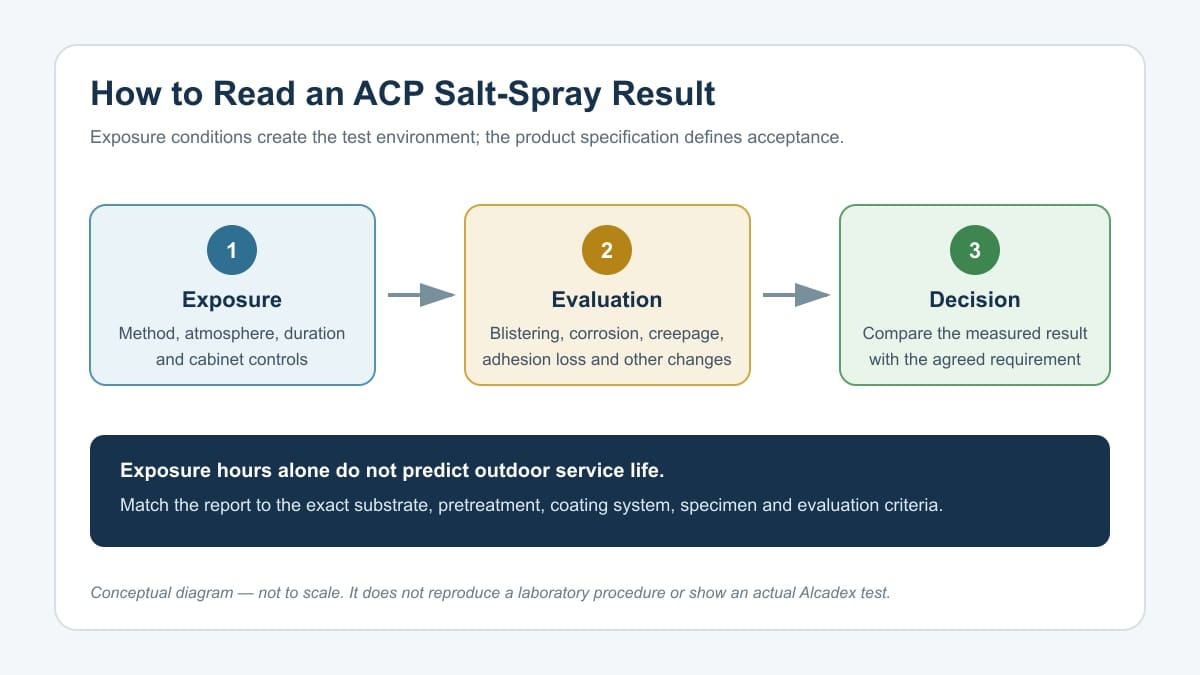
ACP salt-spray testing exposes a coated metal specimen to a controlled saline fog and then evaluates defined signs of corrosion or coating failure. The test can help verify production consistency or a specified coating system, but an exposure time by itself is not a pass result and cannot be converted directly into years of outdoor service.
For buyers, a useful report must identify the test method, atmosphere, duration, specimen construction, surface preparation, scribe and edge condition, evaluation method and acceptance criteria. “Passed 1,000 hours” is incomplete unless the document explains what was inspected, how it was rated and which requirement the specimen satisfied.
What Does an ACP Salt-Spray Test Measure?
A salt-spray or salt-fog test creates a controlled corrosive environment around prepared specimens. It is used with metals and coated metals to reveal behavior such as substrate corrosion, blistering, coating breakdown, corrosion spread from a deliberate scribe, or loss of adhesion associated with corrosion. The exact observations depend on the product specification and evaluation method.
The test does not expose an installed facade to real wind, sunlight, wet–dry cycles, pollutants, temperature changes, joints, fasteners, drainage or maintenance. It also does not assess the complete ACP wall system. It evaluates the submitted specimen under the defined laboratory exposure.
That distinction is especially important for ACP. The face finish is only one part of the product. The aluminum alloy and pretreatment, primer, topcoat, film build, cut edges, fabrication damage, fasteners and dissimilar-metal contacts can all affect corrosion behavior in service. A test on an intact laboratory coupon does not automatically cover routed edges, drilled holes, folded corners or installed interfaces.
| Report item | What it tells the buyer | What it does not establish alone |
|---|---|---|
| Exposure method | How the corrosive test environment was generated and controlled | The product-specific pass criteria |
| Exposure duration | How long the specimen remained in the stated test | Equivalent outdoor years or a pass result |
| Evaluation rating | The observed degree of a named failure mode | Performance for unmeasured failure modes |
| Acceptance criterion | The contractual limit used to judge the result | Suitability for every project or environment |
ASTM B117 and ISO 9227 Define Exposure, Not Every Pass Rule
ASTM B117, Standard Practice for Operating Salt Spray (Fog) Apparatus, defines the apparatus, procedure and conditions used to create and maintain the salt-fog environment. ASTM states that the practice does not prescribe a specimen type, exposure period or interpretation for a specific product. Those elements must come from another product requirement or an agreement between the parties.
ISO 9227:2022, Corrosion tests in artificial atmospheres — Salt spray tests, covers neutral salt spray (NSS), acetic acid salt spray (AASS) and copper-accelerated acetic acid salt spray (CASS). ISO likewise does not set the specimen dimensions, product exposure time or result interpretation. It states that these details belong in the relevant product specification.
The method name therefore cannot replace the acceptance requirement. A complete project statement might identify a salt-spray method, a specified atmosphere and duration, the exact coated specimen, the relevant evaluation procedure and the maximum permitted change. The designer or buyer should not assume that “ASTM B117” automatically supplies all of those decisions.
| Question | ASTM B117 | ISO 9227 | Procurement implication |
|---|---|---|---|
| What is primarily defined? | Operation of a controlled salt-spray apparatus | Apparatus, reagents and procedures for named salt-spray atmospheres | Name the method and atmosphere required |
| Is product exposure time supplied? | No | No | State the duration in the product or project specification |
| Are universal pass criteria supplied? | No product-specific interpretation is prescribed | Interpretation comes from the appropriate product specification | Name the evaluation method and permitted result |
| Does the test predict service life? | Stand-alone results seldom correlate predictably with natural exposure | Not intended to predict long-term corrosion resistance | Do not convert chamber hours into facade years |
Why Salt-Spray Hours Cannot Be Converted into Years
A common mistake is to treat accelerated exposure as a time-compression formula: a certain number of laboratory hours is presented as a certain number of coastal years. Neither ASTM B117 nor ISO 9227 supports a universal conversion. Natural environments combine changing moisture, temperature, ultraviolet radiation, pollutants, deposits, cleaning and design details in ways that a continuous salt fog does not reproduce.
ASTM warns that natural-environment performance has seldom correlated with stand-alone salt-spray results and that extrapolation is not always predictable. ISO states that salt-spray methods are not intended to rank different materials for corrosion resistance or predict long-term resistance. This does not make the test useless. It means the result should be used for the purpose defined by the product specification, such as checking continuity or consistency of a protective system.
Two products can also respond differently to accelerated and natural exposures because their corrosion mechanisms differ. A longer duration is not automatically a more realistic test. The appropriate method and acceptance criteria should reflect the coating system, substrate and intended qualification purpose.
What Should Be Evaluated After Exposure?
The chamber exposure and the post-exposure evaluation are separate. A report should identify the observations made and the rating method used. Depending on the specimen and specification, these may include corrosion on the general surface, corrosion spread from a scribe, blistering, flaking, adhesion loss or changes at edges.
ASTM D1654 for evaluating painted or coated specimens after corrosive exposure covers treatment and evaluation related to corrosion, blistering associated with corrosion, loss of adhesion at a scribe and other film failure. Other evaluation standards may be used for particular observations. The report should name them rather than rely on an unexplained word such as “pass.”
For ACP, the condition of the specimen affects what the result can show. An unscribed face evaluates a different condition from a deliberately scribed coating. Sealed edges differ from exposed cut edges. A flat coupon does not include routed grooves, folds, fastener holes or sealant interfaces. Each configuration answers a different question.
Match the Report to the Quoted ACP Construction
Begin with traceability. The report should identify the aluminum substrate or product, pretreatment, primer, topcoat, finish, film build and batch or sample code when relevant. A generic coating brochure may support early screening, but it does not automatically prove the exact ACP configuration being quoted.
Next, confirm whether the specimen represents the panel face only or an actual fabricated detail. If a project is concerned about cut-edge exposure, folded corners or dissimilar-metal contacts, an intact flat specimen may not address the risk. Those conditions may need separate design controls, materials selection or project-specific testing.
Finally, check the document’s scope. “Tested according to” identifies a method; it does not mean certified, approved for the project or suitable for every coastal environment. Project acceptance still depends on the specification, complete system, local requirements and appointed approval authority.
How to Read Common Result Statements
| Statement in a quote or report | What is missing | Better follow-up question |
|---|---|---|
| “Passed salt spray” | Method, duration, specimen, evaluation and limit | Which exact requirement was met, and where is the result recorded? |
| “No corrosion after X hours” | Location, rating method, scribe and edge condition | Was the face, scribe, edge or all three evaluated? |
| “Coastal grade” | Measurable construction and project basis | Which coating, substrate and test requirements define that term? |
| “Equivalent to X outdoor years” | Validated correlation with the relevant natural exposure | What long-term field evidence supports that conversion? |
| “ASTM B117 compliant” | Product-specific duration and acceptance criteria | What specimen and evaluation requirement was used with the apparatus practice? |
Why Replicates and Chamber Control Matter
One specimen gives limited information. ASTM B117 notes that reproducibility depends on specimen type, evaluation criteria and control of operating variables, and that similar specimens can vary between chambers even when the nominal conditions are within the specified ranges. A test plan should therefore include enough replicate specimens to reveal variability rather than treating one convenient coupon as the whole result.
The laboratory record should show that the chamber environment was monitored as required by the chosen method. Interruptions, specimen position and handling should be documented when relevant. If one specimen behaves differently from the others, the report should preserve that result and investigate the cause; it should not report only the most favorable panel.
Before-and-after photographs are useful for traceability when their lighting, distance and specimen identity are controlled. They do not replace the named evaluation method. Deposits may also affect what is visible when a specimen first leaves the chamber, so the report should state when and how evaluation occurred in accordance with the selected procedure.
Color or gloss change should be treated separately from corrosion unless the product specification combines those observations. If color difference is required, define its measurement conditions rather than estimating it from photographs. The guide to ACP Delta E color measurement explains how a numerical color result depends on its own reference, formula and instrument settings.
RFQ and Submittal Checklist
If salt-spray evidence is required, define it before production so suppliers can quote and document the same scope. Include the following information in the RFQ, finish schedule or technical submittal:
- Exact exposure standard and edition, such as the specified ASTM or ISO document.
- Salt-spray atmosphere required where the standard offers more than one option.
- Exposure duration taken from the applicable product or project requirement.
- Complete specimen identity: substrate, pretreatment, primer, topcoat, finish and film build.
- Whether the sample is scribed or unscribed and how edges are prepared or protected.
- Number of specimens, replicate plan and any control specimens.
- Named evaluation methods for corrosion, creepage, blistering, adhesion loss or other failure modes.
- Numerical or descriptive acceptance criteria for every evaluated item.
- Laboratory, report date, specimen photographs and traceable sample or batch references.
- Required action if the result does not meet the agreed limit.
Place this evidence beside the product data and finish sample in the ACP technical submittal. That prevents a report for one coating construction from being approved alongside a quotation for another.
Salt-Spray Results and Coastal ACP Selection
A salt-spray report can inform coastal procurement, but it should not be the only selection input. Exposure severity, distance from salt sources, prevailing wind, sheltered deposits, rainfall, cleaning access and maintenance all affect real service conditions. Detail design also controls whether water and salts remain trapped at edges, joints or fasteners.
Buyers should review the panel finish together with fabrication scope, compatible fasteners and accessories, joint design, drainage and cleaning requirements. Damage during transport or fabrication can create conditions that the original intact specimen did not represent. Receiving inspection should record surface and edge condition before installation; the ACP receiving inspection checklist provides a practical framework.
Warranty language should also be read separately from the test report. A laboratory exposure does not automatically create coverage. Check the named product, environment, exclusions, maintenance obligations and claim procedure in the actual warranty terms. See our guide to ACP warranty coverage and buyer checks.
Common Interpretation Mistakes
Counting hours without reading the result
Duration is only one test parameter. A buyer needs the observed failure modes, ratings and acceptance limits before deciding whether the specimen passed.
Treating one coating coupon as proof for every panel
The report scope may be limited by substrate, pretreatment, color, coating system, film build or sample preparation. Match it to the exact quoted construction.
Comparing unlike materials by exposure time alone
Salt-spray standards warn against using the test as a simple long-term ranking tool. Different systems can fail through different mechanisms and may not rank the same way outdoors.
Ignoring scribes and edges
An intact surface, a deliberate scribe and a cut edge represent different conditions. A report should state which were present and how each was evaluated.
Calling a test result a certification
A report records testing and observations within its scope. It is not automatically a product certification, code approval or complete-system approval.
Frequently Asked Questions
What is a good salt-spray test duration for ACP?
There is no universal duration for every ACP coating and project. The applicable product, coating or project specification should define the exposure time and acceptance criteria.
Does 1,000 hours of salt spray equal a number of outdoor years?
No universal conversion is supported. Natural exposure includes variables that continuous salt fog does not reproduce, so hours should not be translated directly into service life.
Does ASTM B117 include pass/fail requirements?
ASTM B117 defines the test environment and operation. It does not prescribe the specimen, exposure period or product-specific interpretation. Those requirements must be supplied separately.
Is ISO 9227 the same as ASTM B117?
Both address salt-spray exposure, but they are separate standards with their own scope and requirements. The specification and report should identify the method actually used.
Can salt-spray testing prove that installed ACP will not corrode?
No. It evaluates a defined specimen in a controlled chamber. Installed performance also depends on fabrication, edges, fixings, joints, drainage, environment and maintenance.
Request Traceable Test Evidence
A credible ACP salt-spray requirement connects three things: a controlled exposure, a defined evaluation and an agreed acceptance rule. Exposure hours alone do not complete that chain. Before ordering, verify that the report represents the quoted coating construction and that every pass statement can be traced to a named criterion.
If your project requires coating or corrosion evidence, send Alcadex the intended application, environment, panel construction, finish specification and named test requirements through our contact page. Request the available technical data and documentation for the exact product included in the quotation.